


Chronic relational disconnection is not a soft variable. For executives and founders operating under sustained high-output conditions, the absence of consistent, intentional partnership engagement correlates with measurable elevations in basal cortisol, accelerated biological aging markers, and increased cardiovascular event risk — outcomes no performance protocol can fully offset. The research is unambiguous: social bonding quality is a primary modulator of allostatic load. Yet most high-performing professionals invest in sleep architecture, VO2 max, and metabolic panels while leaving their most physiologically consequential relationship to run on inertia. A healthy partnership, however, is central to reducing those biological risks. That neglect has a biological cost. This article addresses how to correct it.
The Biology of Relational Neglect

The human nervous system does not tell apart professional stress from relational stress. In fact, both switch on the body's stress hormone system. This triggers Oxytocin release. When ongoing, that release weakens immune function, damages cell structures, and drives body-wide swelling. What makes partnership stress distinct, however, is how long it lasts. A difficult board meeting ends. A strained or emotionally absent relationship, by contrast, does not.
The Harvard Study of Adult Development spans more than 80 years. It is, therefore, one of the longest-running studies on human health. It always identifies relationship quality as one of the strongest signs of late-life health and brain function. Notably, its findings outperform cholesterol levels, exercise habits, and income as a forecasting tool. Moreover, multiple long-term studies have confirmed this result across different groups.
Relational quality is not merely an emotional factor. It is, in fact, a physical one. Specifically, it has real, trackable effects on hormone function, immune activity, heart health, and cell aging. Therefore, professionals who treat partnership health as less important than physical improvement are, by the evidence, working against themselves.
READ ALSO: Why Chronic Overstimulation Raises Biological Age and How Intentional Calm Reverses It
Why High Performers Are Particularly Exposed

The professional profile that defines WholeLiving's readership creates specific risk in close partnerships. This includes high mental load, tight schedules, frequent travel, and identity tied closely to output. Presence is the core currency of relational connection. Yet it is exactly what high performance tends to wear down first. As a result, partnerships often remain intact on the surface while becoming hollow underneath.
This is not a moral failure. Rather, it is an expected outcome of resource use without deliberate adjustment. The high performer often improves sleep, nutrition, and exercise. Yet they leave relational connection to run on autopilot. Consequently, this creates an ongoing stressor that works below their level of awareness. That stressor, in turn, generates real physical harm for both partners.
What further adds to the risk is the habit of treating relational neglect as short-term. The next quarter, the next round, the next exit — these become unspoken promises. Specifically, the promise is that connection will resume when pressure lifts. The research, however, does not support this delay strategy. Relational health declines during lasting neglect. Furthermore, it does not recover on its own when attention eventually returns. This is a pattern WholeLiving's allostatic load assessment tracks directly.
Cortisol Dysregulation and the Relational Feedback Loop
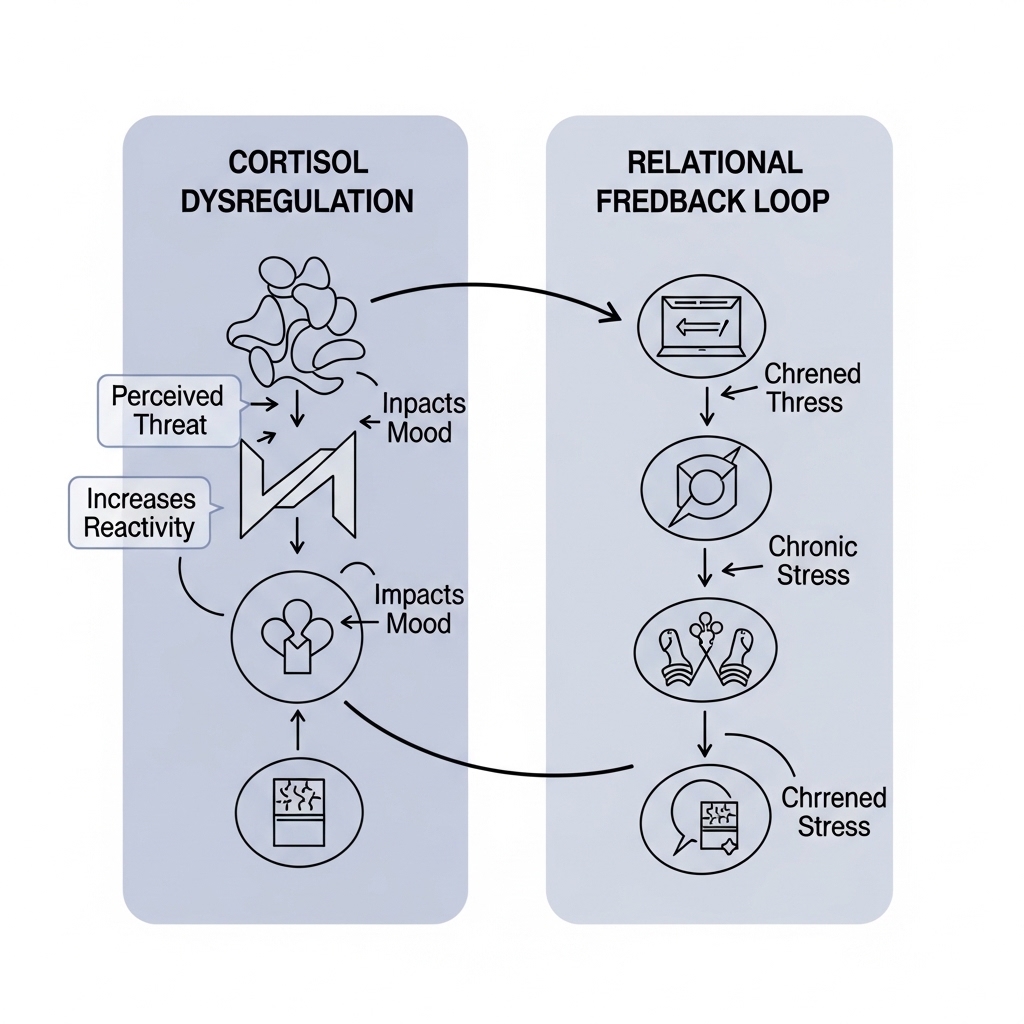
Ongoing relational tension works as a lasting low-grade stressor. Short-term stressors trigger a cortisol spike followed by a recovery period. Relational stress, by contrast, produces lastingly high base-level cortisol. Over time, therefore, this pattern drives belly fat build-up, insulin resistance, broken sleep, and a weakened immune response. The body's stress system was simply not built for endless switching on.
The Gottman Institute‘s long-term research spans decades and tens of thousands of couples. It shows that physical signs of stress during conflict directly predict both relationship breakdown and individual health decline. These signs include raised heart rate, increased cortisol, and heightened skin response. Notably, this is a heart and hormone finding. Its effects, therefore, extend well beyond the relationship itself.
The feedback loop in lastingly stressed partnerships is particularly damaging. Raised cortisol reduces the ability to manage emotions. Reduced emotional control then increases the likelihood of conflict or pulling back. Conflict and pulling back, in turn, further raise cortisol. Consequently, high performers near the upper edge of their stress capacity are especially at risk. They have fewer resources available to break this cycle.
READ ALSO: What Are Intimate Relationship: Insights to Nurture Closeness
Oxytocin as a Longevity Variable
Oxytocin works as a genuine physical regulator. It is not simply a “bonding hormone.” Rather, it influences heart function, pain response, and stress control. Physical touch, eye contact, shared positive experience, and verbal acknowledgment all trigger oxytocin release from the brain. As a result, higher oxytocin levels are linked to reduced cortisol response, lower blood pressure, and faster healing.
Most professionals tracking health markers do not include oxytocin on their panels. Yet its ongoing reduction through relational neglect may quietly undermine outcomes they work hard to improve elsewhere. Specifically, oxytocin directly lowers stress hormone activity. Regular relational connection therefore acts as a physical buffer against the stress load high performers routinely carry. Without this buffer, steps taken to target cortisol address the result while the root cause keeps operating.
Studies published in Psychoneuroendocrinology have shown that oxytocin reduces body swelling through specific cell signaling pathways. This, therefore, connects relational connection directly to one of the most important processes in aging and long-term disease. For professionals who track swelling markers as health factors, the oxytocin-inflammation link is, consequently, an under-examined and changeable input.
Sleep Quality and Partnership Dynamics

Sleep is the most well-documented recovery factor in performance medicine. Its disruption, moreover, carries effects across nearly every body system relevant to longevity and high-level function. What professionals less often examine, however, is how relational quality shapes sleep. This happens well before the behaviors most focus on, including light exposure, room temperature, and supplements. A study published in Social Psychological and Personality Science found that people reporting higher relationship satisfaction showed better sleep quality. They also showed fewer nighttime wake-ups, apart from other sleep habits.
The process aligns with stress load theory. Unresolved relational tension raises evening cortisol and delays the onset of sleep hormones. It also increases overnight nervous system activity. Each of these effects, therefore, breaks up sleep and reduces time in deep and REM stages. As a result, a lastingly strained partnership is an earlier factor that later sleep optimization steps cannot fully fix.
The shared sleep setting also matters in a direct physical way. Research on adult bonding shows that sleeping near a securely connected partner measurably calms the body's nervous system. It consequently reduces heart rate disruption and overnight cortisol output. When relational tension defines the partnership, however, this calming effect disappears. The sleep setting then becomes a context for activation rather than recovery.
READ ALSO: Intentional Social Diversity Reduces Inflammatory Load and Extends Cognitive Resilience in High-Performing Adults
The Inflammatory Consequence
Ongoing body-wide swelling drives biological aging, heart disease, brain decline, and blood sugar problems. C-reactive protein, interleukin-6, and tumor necrosis factor-alpha are now standard reference points in longevity medicine. What performance health contexts rarely address, however, is how directly relational quality shapes these markers.
Research led by Janice Kiecolt-Glaser at the Ohio State University Institute for Behavioral Medicine Research shows clear results. Couples engaging in high-hostility conflict display measurably raised swelling markers. These include IL-6 and TNF-alpha. This held true even after controlling for diet, exercise, and sleep. Critically, moreover, the swelling response was not short-lived. Couples with lastingly hostile patterns showed raised marker levels over time. This finding, therefore, has direct effects on heart disease and cancer risk.
This carries a specific point for professionals managing body swelling through nutrition and training. If the relational setting generates ongoing low-grade swelling, later steps targeting CRP or IL-6 address the result rather than the cause. Therefore, treating relational quality as an earlier swelling factor — and giving it the same data-driven seriousness — is a logical part of any thorough approach to reducing body-wide swelling.
What “Relational Rituals” Actually Are

The clinical literature on couple functioning regularly identifies behavioral consistency as the main driver of relational security and physical regulation. Notably, intensity matters far less than consistency. Relational rituals are not sentimental gestures. Rather, they are planned, repeated behaviors that signal presence, priority, and connection. In the brain, they build a sense of safety within the bonding system. This, in turn, reduces the threat response and creates the physical conditions for recovery and shared calming.
Recorded examples include dedicated, distraction-free conversation at regular intervals. Others include non-sexual physical contact, expressed appreciation, and shared transition routines at arrival and departure. None of these demand significant time. All demand deliberate attention, however. This is exactly what high-output professional lives tend to redirect away from relational contexts and toward task completion.
The regularity of these behaviors matters more than their length or emotional weight. A partnership with brief, regular daily signals of connection builds a different brain profile. This contrasts, therefore, with one where connection is saved for weekends or vacations. Furthermore, the bonding system adjusts by frequency and reliability — not by the scale of individual gestures. This principle, in turn, aligns closely with the regularity-over-intensity logic most high performers already apply to training and habit building.
Presence as a Physiological Input

In performance contexts, professionals discuss presence as a mental state. Specifically, it is relevant to focus and decision-making. In relational contexts, however, it works as a direct physical input for a partner's nervous system. It has real effects on their stress levels, immune function, and heart health. Research on shared calming in adult bonding consistently shows that genuine connection is the active factor in relational stress reduction. Mere closeness, by contrast, is not enough.
When one partner is physically present but mentally absent, the other partner's nervous system reads this as relational distance. Mental absence includes reviewing a device, processing work, or being emotionally checked out. This is not a conscious reading of the situation. Rather, it is an automatic response. It is processed, specifically, through the same neural circuits that assess social threat and safety. The result is mild but lasting stress activation. Over time, consequently, this builds into real physical burden.
Research on adult bonding shows that a calm, connected partner measurably reduces cortisol response in the other person during stress. The inverse, however, is equally well-documented. Emotional distance — even with physical closeness — removes a key calming resource and raises stress load. For high performers already carrying raised stress, therefore, the presence or absence of this buffer is a meaningful factor in overall physical recovery.
The Compounding Return on Relational Investment

High performers are fluent in compounding return logic. They apply it to capital, skill building, and health behaviors. The same logic, therefore, applies to relational health. Small, regular deposits of attention, repair, and appreciation build over years into a partnership defined by secure bonding and low ongoing stress. Each deposit may appear modest on its own. Its value, however, lies in the build-up.
Conversely, small, regular withdrawals also compound. Distraction, dismissal, and emotional absence build into a relational setting that raises stress load for both people. The Harvard Study of Adult Development makes this clear. Relationship quality at midlife is, consequently, one of the strongest predictors of physical health, brain function, and wellbeing in later decades. Furthermore, this pattern does not stem from dramatic partnership events. It stems, instead, from the built-up quality of daily relational experience across years.
The professional habit of putting off relational investment is not in line with how the bonding system works. Heart fitness cannot be stored through short-term training and maintained through inactivity. Relational security, similarly, works the same way. In both cases, therefore, the biology responds to what happens regularly — not to what was invested in the past or planned for the future.
Cognitive Performance and Relational Security

Thinking performance responds directly to ongoing stress load. This includes processing speed, working memory, decision-making, and creative reasoning. The front region of the brain governs higher-level thinking. It is, therefore, especially at risk from cortisol-related harm. Ongoing stress reduces the size of this region over time. It also, consequently, limits real-time access to brain resources required for complex decisions.
A partnership defined by unresolved tension or emotional ups and downs uses up mental bandwidth. This is bandwidth that would otherwise support high-level professional function. Ongoing relational stress switches on the brain's alert center. It consequently holds it in a state of low-grade readiness. As a result, this uses up attention no matter whether the person consciously thinks about the relationship. Executives who believe they separate relational difficulties from work performance are, therefore, likely overestimating their own mental insulation.
A relationally secure partnership, by contrast, works as what bonding researchers call a “safe haven.” It is a mental base that expands rather than limits available resources. When the relational setting feels stable and predictable, the brain's alert system reduces its activity. This, in turn, frees up mental resources for complex reasoning and strategic thinking. Therefore, the thinking performance case for investing in partnership quality is also, directly, a professional performance case.
Repair as a Performance Protocol
Relational repair ranks among the most clinically significant factors in couple health research. It is the process by which partners notice breaks in connection and deliberately rebuild it. It does not require the absence of conflict. Rather, it requires a regular response to disconnection. This, in turn, prevents the build-up of unresolved relational stress and its related physical load. The Gottman Institute‘s long-term data identifies repair attempts — not conflict avoidance — as the main factor separating stable from unstable partnerships.
High performers who apply planned rigor to relational repair build partnerships with notably lower ongoing stress loads. The parallel to post-performance reviews is, therefore, clear. A debrief following a poor outcome prevents the build-up of strategic errors. Similarly, a relational repair following disconnection prevents the build-up of bonding insecurity. Both are, consequently, corrective steps applied before decline becomes structural.
Research supports that brief, regular acknowledgment of disconnection interrupts the cortisol feedback loop. This should be followed, moreover, by deliberate reconnection, however small. Extended processing at the moment of a break is not necessary. In fact, a genuine expression of ownership and re-engagement shifts the brain state of both partners. Even within a few minutes, therefore, this shift occurs in ways that long conflict or silence simply do not produce.
The Cardiovascular Argument

The heart health case for relational quality draws on data from large population studies. These span multiple decades and regions. The Framingham Heart Study is one of the most referenced heart research programs in medical history. It has, therefore, contributed data showing that social connection and relationship quality on their own predict heart event rates and death. These links operate through pathways separate from standard risk factors. Standard risk factors include lipid profiles, blood pressure, and smoking. Furthermore, analyses drawing on hundreds of thousands of participants across multiple countries have confirmed these findings.
Partnered people with high relationship satisfaction show reduced rates of heart events. They also show lower resting blood pressure and better survival after cardiac events. This contrasts, therefore, with those in low-quality partnerships. The direction of this relationship is now well-established. It is not simply that healthier people form better relationships. Rather, better relationships produce measurably better heart outcomes. This holds true, moreover, even after accounting for baseline health and health behaviors.
For professionals monitoring heart metrics, this data introduces a factor most standard plans do not address. These metrics include resting heart rate, heart rate variability, and blood pressure trends. Reduced cortisol load, improved sleep, lower body-wide swelling, and better nervous system regulation all connect partnership quality to heart health. As a result, addressing each of these without addressing the relational setting that drives them remains an incomplete strategy.
Evidence-Based Options for the High-Performing Professional
The evidence reviewed here supports several behavioral approaches. These align well with demanding schedules. Establishing brief, regular daily connection intervals requires no significant schedule changes. Specifically, ten to twenty minutes of undivided, device-free interaction aligns with the relational ritual literature. Moreover, applying a planned repair approach to relational conflict reduces ongoing cortisol exposure. This can be done as regularly as a professional review process, without demanding extended time.
Periodic check-ins, conducted weekly or biweekly, work similarly to performance reviews. They support lasting relational health. They also, therefore, surface building strain before it grows into something harder to address. For those managing significant relational tension, working with a clinically trained couples therapist is a research-backed option. It has documented results across multiple controlled trial designs. This is, consequently, a performance-relevant decision, not a last-resort one.
Each of these approaches targets a documented physical factor. Furthermore, each can be tracked over time against real outcomes. These include sleep quality, perceived stress load, swelling markers, and heart metrics. These are, therefore, the same factors that define the broader WholeLiving performance framework.
Chronic relational disconnection is one of the most overlooked drivers of accelerated biological aging, with persistently poor relationship quality linked to raised inflammatory markers, disrupted sleep architecture, and elevated cortisol — factors that, together, can add an estimated two to five years to biological age in large-scale population studies. WholeLiving's Biological Age Estimation Model incorporates this factor directly — your assessment takes under five minutes.