

Sustained cognitive overload is not a productivity problem — it is a physiological one. For executives and founders operating under persistent high-stimulus conditions, chronic overstimulation drives cortisol dysregulation, suppresses heart rate variability, and accelerates biological aging in patterns that are measurable and clinically significant. The professional who fills every margin with input, obligation, and noise is not optimizing performance. They are eroding the neurological substrate that performance depends on. Adopting a minimal lifestyle, with deliberate reduction of cognitive and environmental load, is not a lifestyle preference. It is a clinical intervention — one with documented downstream effects on inflammatory markers, sleep architecture, and long-term cognitive resilience.
The Neuroscience of Cognitive Overload

The human nervous system was not built for the input volume that marks modern executive life. Continuous partial attention — being always connected, always responsive, and always task-switching — holds the body's stress system in a state of low-grade activation.
The brain does not tell the difference between a physical threat and an unread message queue. Both fire the same stress circuitry and produce cortisol. Sustained over time, this pattern disrupts sleep, raises inflammation, and drives clear cognitive decline.
Research from the National Institutes of Health consistently shows that the prefrontal cortex — the region responsible for strategic thinking and clear decisions — is among the first areas to show impairment under sustained cognitive demand. The executive with no unstructured time in their day is not showing discipline. Instead, they are steadily wearing down the biological base their decisions depend on.
READ ALSO: Minimal Lifestyle To Build Space For Real Growth
What Chronic Overstimulation Does to Inflammation
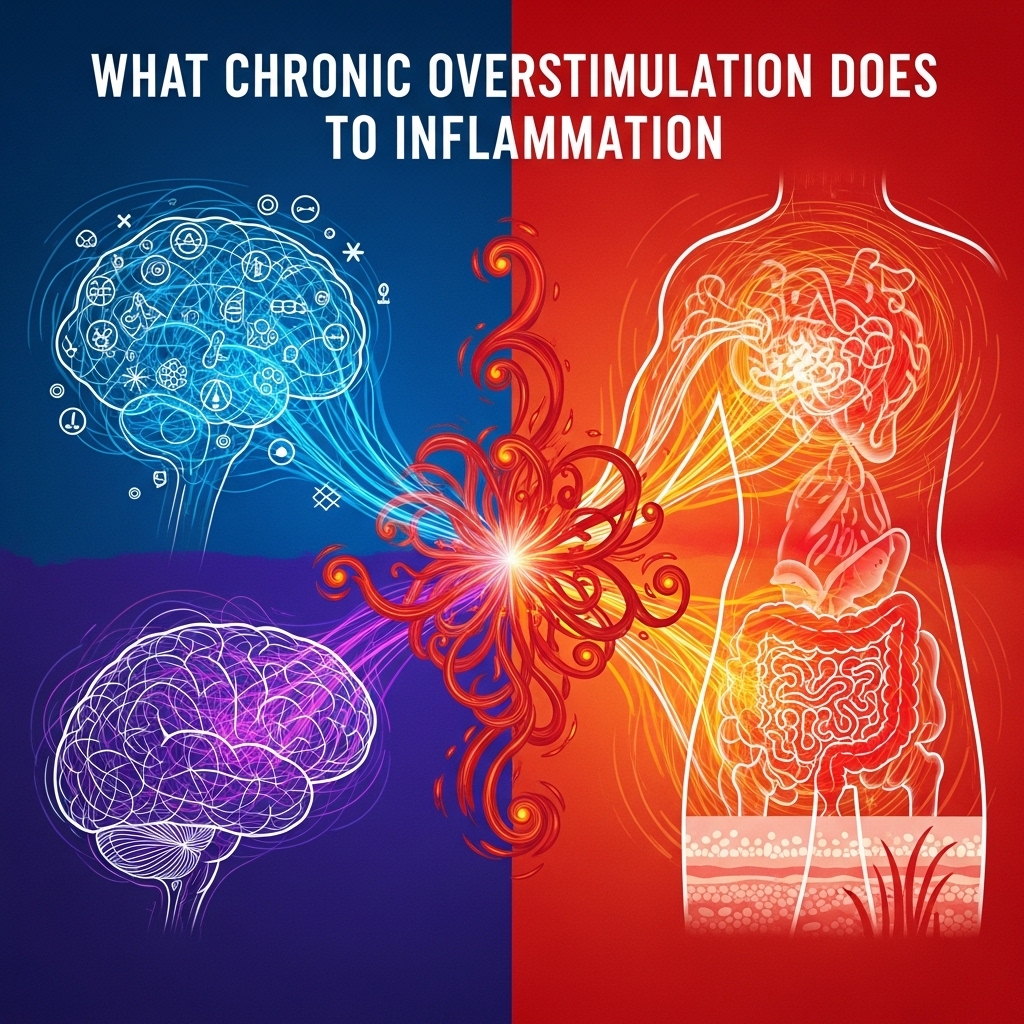
Inflammation is the common pathway through which chronic stress causes physical harm. Sustained overstimulation raises key inflammation markers — including IL-6 and CRP — in patterns seen in people under heavy long-term stress.
These markers are not abstract. Elevated CRP predicts heart risk, while elevated IL-6 links to faster biological aging and cognitive decline. The Framingham Heart Study identified psychosocial stress and poor social engagement as independent risk factors for heart disease.
Notably, these effects held even after researchers controlled for blood pressure, cholesterol, and body weight. Overstimulation and the absence of genuine rest, therefore, carry a real heart health cost. Furthermore, that cost builds silently over years.
READ ALSO: 4 Steps to Reducing Chronic Inflammation – Whole Living Wellness
The Biology of Purposeful Stillness
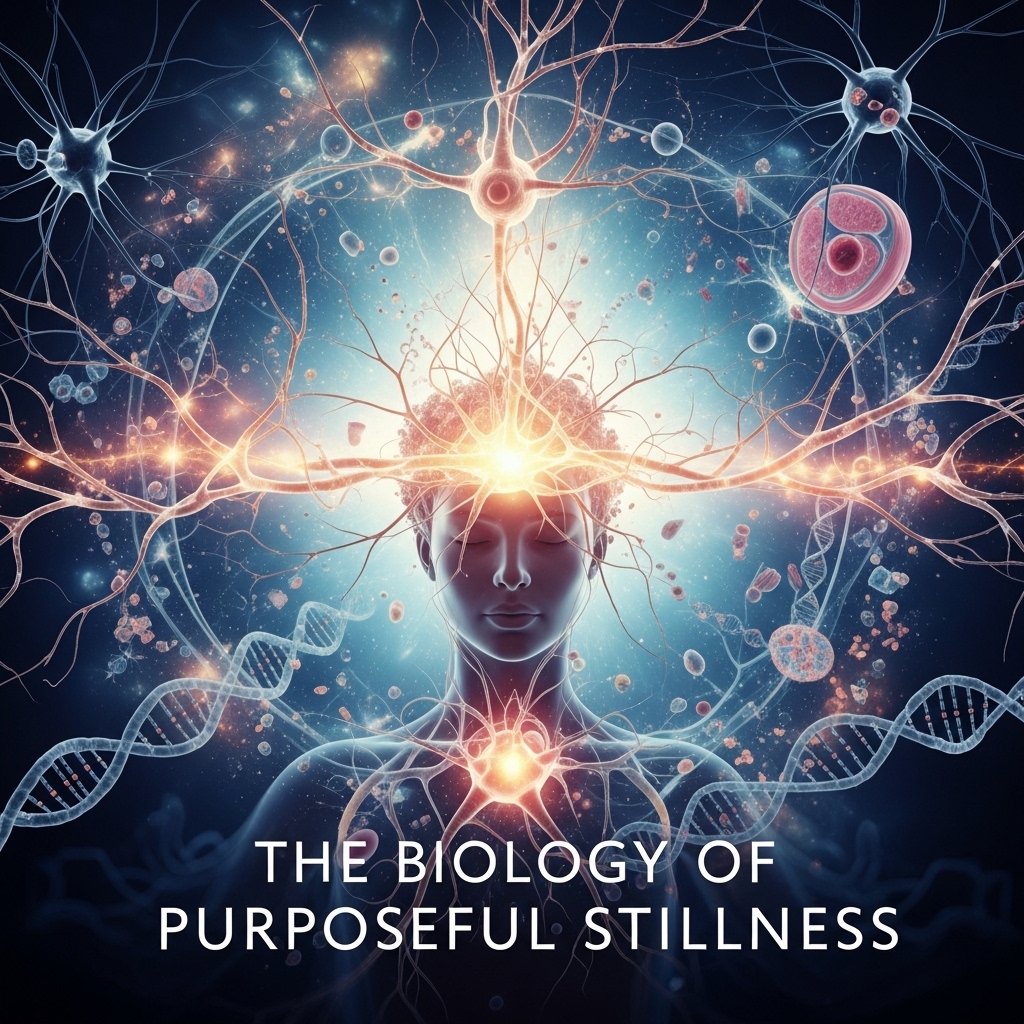
Deliberate stillness is not the absence of productivity. Rather, it is a distinct physical state with clear markers. When the nervous system shifts from its active, stress-driven state to recovery mode, HRV rises, cortisol drops toward baseline, and the prefrontal cortex regains capacity.
This shift does not happen on its own in high-stimulus settings. Instead, it requires conditions the modern professional schedule rarely provides: low sensory input, low social demand, and no outcome pressure.
Research in stress biology consistently shows that waking rest — with low cognitive load and low environmental input — produces clear nervous system recovery. The quiet walk and the open afternoon are therefore not indulgences. They are recovery inputs with clear physical effects.
READ ALSO: Adventure with a Purpose for a New Kind of Growth
Purpose as a Biological Variable

The link between a clear sense of purpose and measurable health outcomes is among the more robust findings in longevity research. Work from the Harvard T.H. Chan School of Public Health, drawing on the Nurses' Health Study and related groups, has linked higher purpose scores to reduced heart disease risk, lower stroke rates, and slower biological age progression.
The mechanism is not purely psychological. Purpose appears to dampen the body's stress response. Specifically, people with stronger purpose show lower cortisol reactivity to acute stressors and faster recovery following challenge. For high-performing professionals whose identity ties closely to output, this matters greatly.
When work becomes the sole source of meaning, its removal produces a stress response rather than a recovery response. Purpose that extends beyond professional output, by contrast, functions as a biological buffer. It measurably reduces the physical cost of operating under pressure.
READ ALSO: What Is the Purpose of Living? You Get to Decide
The Cognitive Cost of Cluttered Spaces

The external environment is not a passive backdrop to cognitive function. Research in environmental psychology shows that cluttered, high-stimulus spaces maintain low-grade attentional demand. The brain continuously processes background visual and auditory input, even when conscious attention focuses elsewhere.
As a result, this drains working memory and reduces the quality of creative and strategic thinking. A study published in the Journal of Neuroscience using functional MRI showed that competing visual stimuli reduce the brain's ability to focus and process information.
The conclusion is direct. Visually simple, acoustically managed spaces — free of unresolved task cues — produce measurable gains in attentional capacity. Environmental design, therefore, is not an aesthetic choice. For the high-performer, it is a cognitive performance variable.
READ ALSO: Regulating Your Autonomic Nervous System Through Mindfulness to Sustain Executive Cognitive Performance
Silence, Rest, and Cognitive Recovery

The brain's default mode network (DMN) — active during rest, reflection, and open thinking — plays a central role in memory, creative insight, and long-term planning. Active task engagement suppresses the DMN, and genuine rest is what allows it to function.
Consequently, the professional who removes all unstructured time from their schedule is not helping this system. They are shutting it down daily. Research from Duke Medical Center found that two hours of silence per day produced measurable new cell growth in the hippocampus — the brain region central to memory and spatial thinking.
Hippocampal health is a key predictor of cognitive strength across the lifespan. Silence, then, is not empty time. Rather, it is a specific input that produces specific biological outputs.
READ ALSO: Emotion Regulation, the Quiet Way Through Nature
Choosing Less as a Performance Strategy

The reduction of duties and inputs typically appears as a lifestyle choice. The physiology, however, frames it differently. Every decision uses up prefrontal resources. Every unresolved duty maintains a low-level activation signal in working memory.
Furthermore, every unnecessary input competes for attentional bandwidth. The result of a life built around maximal engagement is a nervous system that never fully recovers. Strategic removal — deliberately cutting low-value inputs and duties — carries real cognitive and physical effects.
Reduced decision load links to improved decision quality in high-stakes settings. Similarly, reduced environmental noise links to better sleep and faster HRV recovery. The professional who chooses less, therefore, is not stepping back from performance. They are removing the friction that limits it.
READ ALSO: Magical Mind Practices to Calm Your Thoughts
Sleep and the Role of Evening Calm

Sleep is the body's primary recovery window for cognitive repair and inflammation control. The quality of that recovery, however, depends heavily on the two to three hours before sleep. Sustained screen exposure, high-stakes communication, and unresolved cognitive tasks in the evening all keep cortisol and nervous system activity elevated past the point where the body would naturally begin winding down.
Research on sleep consistently shows that deep slow-wave sleep — the most physically healing stage — decreases in people who report high pre-sleep mental arousal. During this stage, the body releases growth hormone, carries out cellular repair, and clears inflammation markers.
Consequently, the deep sleep debt that builds in chronically overstimulated professionals is a meaningful driver of faster biological aging — even when total sleep time appears adequate.
READ ALSO: Essential Habits for Better Sleep Every Night
Relationships, Meaning, and the Longevity Signal

Social connection and a sense of meaning do not operate independently of biology. The Harvard Study of Adult Development — tracking people for over 80 years — found that close relationship quality and a felt sense of purpose were among the strongest predictors of late-life health, cognitive function, and longevity.
Moreover, these effects held independent of income, professional status, and standard health markers. The mechanism runs through the same inflammatory and autonomic pathways described throughout this article. Warm social bonds and clear personal meaning reduce stress system reactivity, lower baseline cortisol, and improve HRV.
They function as biological regulators — not in theory, but in measurable fact. The professional who invests in relationships and activities that produce genuine meaning, therefore, is not sacrificing performance. They are building the physical base that sustains it.
READ ALSO: Relationship Violence Hides in Plain Sight
The Attention Economy as a Health Risk

The digital environment is built for continuous engagement. Notification systems, content feeds, and always-on communication tools actively maintain the alert, responsive state that makes stepping away feel costly.
For the high-performer, this creates a specific risk: the inability to tell the difference between genuine priority and manufactured urgency. Chronic exposure to manufactured urgency holds the body's stress system in a state of low-grade activation.
The body does not distinguish between a real crisis and an urgent-flagged email. Both produce cortisol and suppress recovery. The professional without a clear plan for managing digital input, therefore, is not simply distracted. They are physically compromised in ways that build up over time.
READ ALSO: How to Clear Mind When You Can’t Slow Down
The Space Between Stimulus and Response
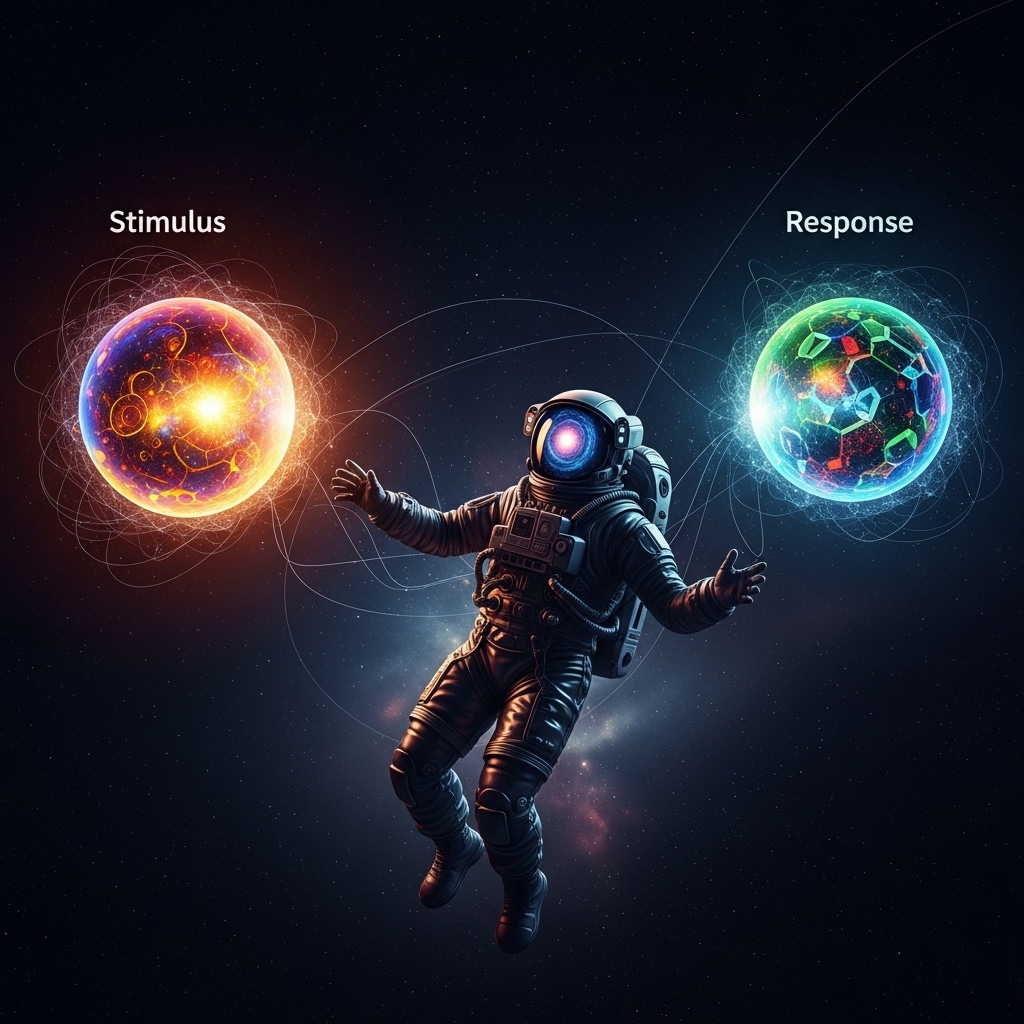
Viktor Frankl's observation — that between stimulus and response there is a space, and in that space lies human freedom — carries a direct neurological parallel. The ability to pause before responding, to sit with uncertainty without immediate action, and to resist reactive behavior is a function of prefrontal strength. Practice builds that strength.
Chronic overstimulation, however, erodes it. Reflective practices — including structured thinking time, breath-focused attention, and deliberate disengagement from task demands — have shown measurable effects on prefrontal function, HRV, and cortisol regulation in peer-reviewed research.
These are not spiritual practices repackaged for a clinical audience. Rather, they are evidence-based inputs with proven physical outputs. The space between stimulus and response, therefore, is not wasted time. It is precisely where cognitive and biological recovery occurs.
READ ALSO: Photographic Mind as a Tool for Mental Resilience
Evidence-Based Options for Reclaiming Cognitive and Biological Capacity
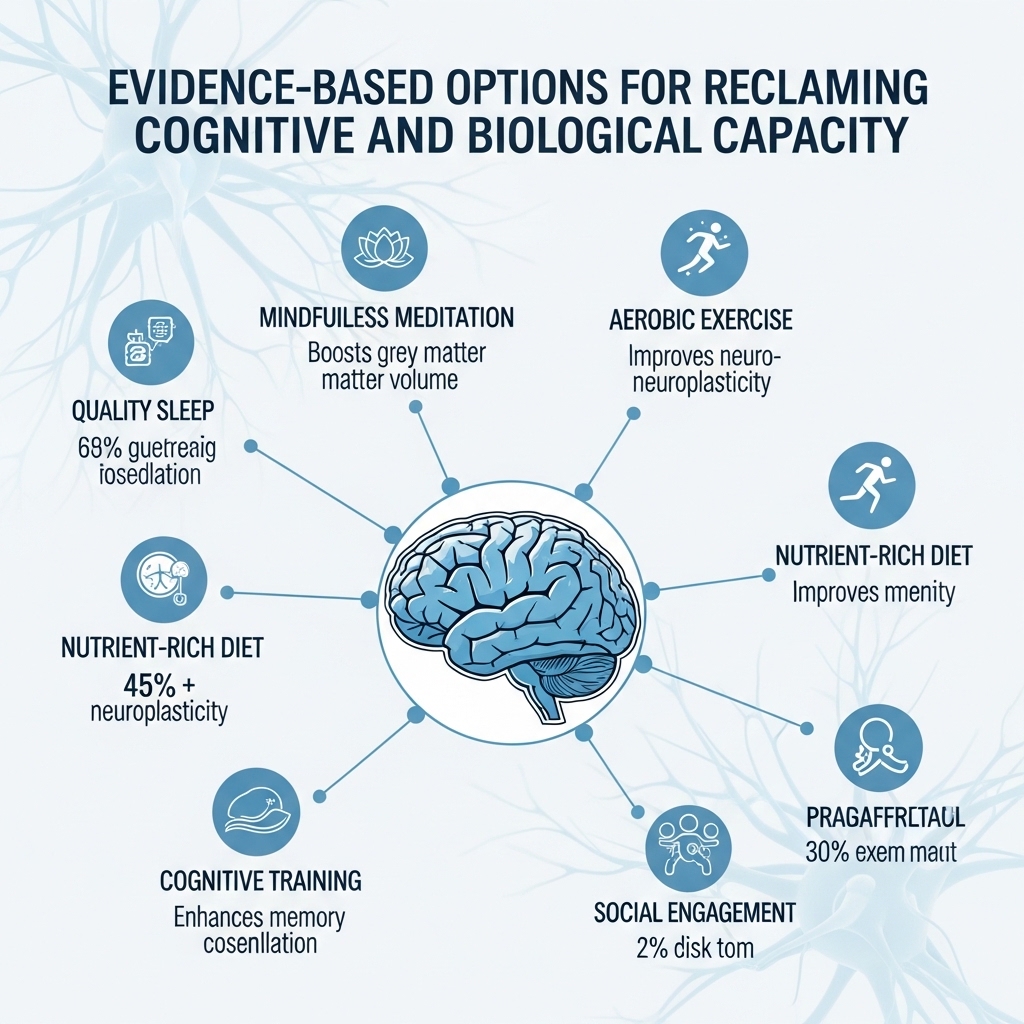
Professionals for whom this evidence is relevant have several well-supported options. First, structuring the day to include genuine unstructured intervals — no task demand, no digital input — supports nervous system recovery and HRV restoration. Second, auditing the physical environment for background cognitive load and reducing it aligns with environmental psychology research as a meaningful performance tool.
Additionally, protecting the two hours before sleep from high-stakes cognitive engagement supports deep sleep and inflammation clearance. Beyond the daily schedule, investing in relationships and activities that produce genuine meaning draws on longitudinal research as an independent protective factor against heart disease, cognitive decline, and faster biological aging.
Finally, developing a clear plan for digital disengagement — defined periods of complete disconnection — reduces stress system activation in patterns that show up clearly in cortisol and HRV data. The evidence does not support framing calm as a retreat from high performance. On the contrary, it supports framing calm as one of the most evidence-informed inputs a serious professional can invest in.
UP NEXT: Regulating Your Autonomic Nervous System Through Mindfulness to Sustain Executive Cognitive Performance
Deliberately reducing cognitive load, digital input, and environmental noise has been shown to lower baseline cortisol, improve heart rate variability, and slow the biological aging process — with research linking sustained psychological overstimulation to measurable increases in inflammatory markers and epigenetic age acceleration. WholeLiving's Biological Age Estimation Model incorporates this factor directly — your assessment takes under five minutes.
Ready to understand how these factors are influencing your biological age right now? [Take the Biological Age Assessment →]