Start with a number that should reframe how you think about easy exercise. One approach gaining attention is Zone 2 Training Benefits Under Longevity Protocols, which highlights the impact of moderate aerobic exercise on lifespan. Across 46 years of follow-up in middle-aged men, the fittest group outlived the least fit by nearly five years, and every small gain in aerobic capacity bought roughly 45 extra days of life (Clausen, JACC, 2018).
That is the quiet engine behind the Zone 2 training benefits everyone keeps talking about. Zone 2 training is the slow, conversational cardio that barely feels like a workout, and the reason serious longevity researchers keep circling back to it is that it builds the exact kind of fitness the mortality data rewards. Think of this as the comprehensive guide a friend who read all the research would give you, including the inconvenient parts.
Here is what catches most people off guard. The real payoff is not your heart rate, your race time, or even fat loss. It runs deeper, down to the microscopic engines inside your cells, and when those engines start to fail, the damage shows up as fatigue, rising blood sugar, and the slow metabolic decline most people quietly write off as normal aging.
“The payoff of increasing your VO2 max is that it makes you functionally younger,” says Peter Attia, MD, in his book Outlive. He is describing your peak aerobic capacity, the ceiling that patient, low-intensity Zone 2 work is built to raise from below.
This data-driven guide walks through what the science actually supports, where the popular story overreaches, and exactly how to build a Zone 2 training program without overthinking it.
What the Science Actually Says About Zone 2 Training Benefits
Before the how, the why. The honest version of the evidence is more interesting than the typical wellness pitch, because the strongest data does not measure “Zone 2” by name at all. It measures cardiorespiratory fitness and physical activity. Those map directly onto the case for endurance training, but the distinction matters, so let us be precise.
Cardiorespiratory fitness and aerobic capacity, in plain English
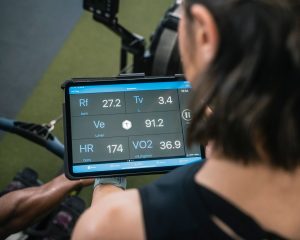
Cardiorespiratory fitness, often shortened to CRF, is how well your heart, lungs, and muscles work together to deliver and use oxygen during effort. The standard yardstick is VO2max, the maximum amount of oxygen your body can use per minute, and it is the cleanest single measure of aerobic capacity. Think of VO2max as the size of your aerobic engine. The bigger and cleaner that engine, the more work you can do and the longer you tend to live. Building aerobic capacity is exactly what Zone 2 does.
The longevity data is overwhelming
In a study of 122,007 adults who completed treadmill testing, higher cardiorespiratory fitness tracked with lower death rates from any cause, and the benefit had no ceiling (Mandsager, JAMA Network Open, 2018). The fitter you were, the longer you tended to live, with no point at which extra aerobic fitness stopped helping. The fittest group, performing at an elite level for their age and sex, had roughly one-fifth the mortality risk of the least fit.
That is not a small effect. It dwarfs the risk reduction from most preventive medications people take.
80% lower all-cause mortality risk — JAMA Network Open, 2018
Among 122,007 adults, those with elite cardiorespiratory fitness had about one-fifth the death risk of the least fit, and the benefit showed no upper limit.
Fitness behaves like a clinical vital sign
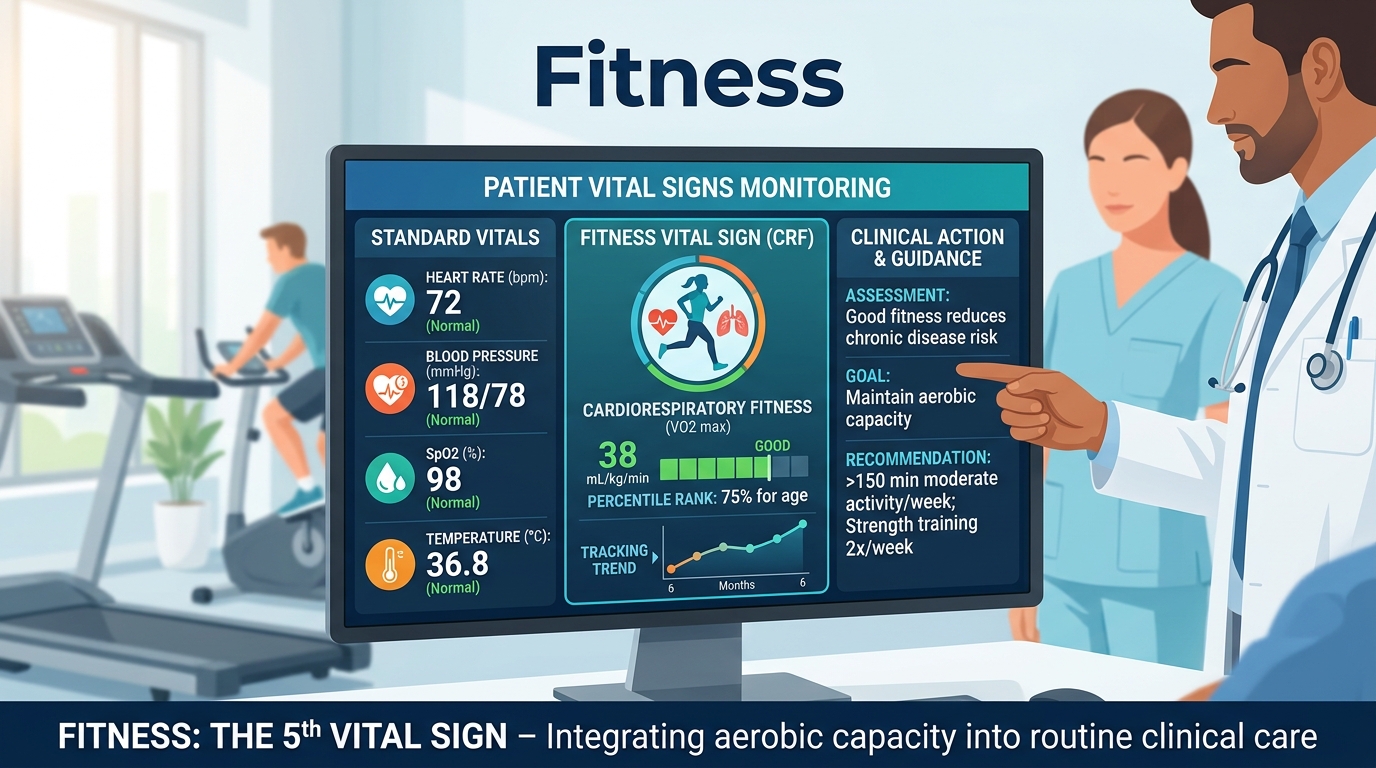
Most people assume the big levers for a long life are cholesterol and blood pressure. Fitness rarely makes the shortlist. The cardiology literature says it should sit near the top.
In 2016 the American Heart Association concluded that low cardiorespiratory fitness predicts death as powerfully as the classic risk factors, including smoking, high blood pressure, high cholesterol, and type 2 diabetes (Ross, Circulation, 2016). The same statement argued that clinicians should measure fitness routinely, treating it like a vital sign. When a body as conservative as the AHA puts aerobic fitness in the same sentence as smoking, it is worth absorbing the implication.
It scales like a dose, not a switch
The payoff is not all-or-nothing. It scales. In the 46-year study mentioned at the top, researchers sorted middle-aged men into fitness categories and watched the gap widen over four decades (Clausen, JACC, 2018). Every one-unit gain in VO2max was associated with about 45 more days of life, and the highest-fitness group lived nearly five years longer than the lowest. The result held even after excluding everyone who died in the first ten years, which weakens the objection that sick people were simply unfit to begin with.
4.9 extra years of life expectancy — JACC, 2018
Across 46 years of follow-up, the fittest middle-aged men lived nearly five years longer on average than the least fit.
Movement itself lowers the risk for the general population

You do not even need a lab test to see the pattern. In the global PURE study of about 130,000 people across 17 countries, higher physical activity was linked to lower rates of death and cardiovascular disease in a dose-dependent way, across rich and poor nations alike (Lear, The Lancet, 2017). For the general population, Zone 2 is simply the most sustainable way to bank that activity.
What Zone 2 Actually Is
The term comes from a system of training zones, usually five, that map intensity from very easy to all-out. The exact numbers vary by model, which is part of why the topic confuses people. What matters is not the label but the physiology underneath it.
The training zones, simplified
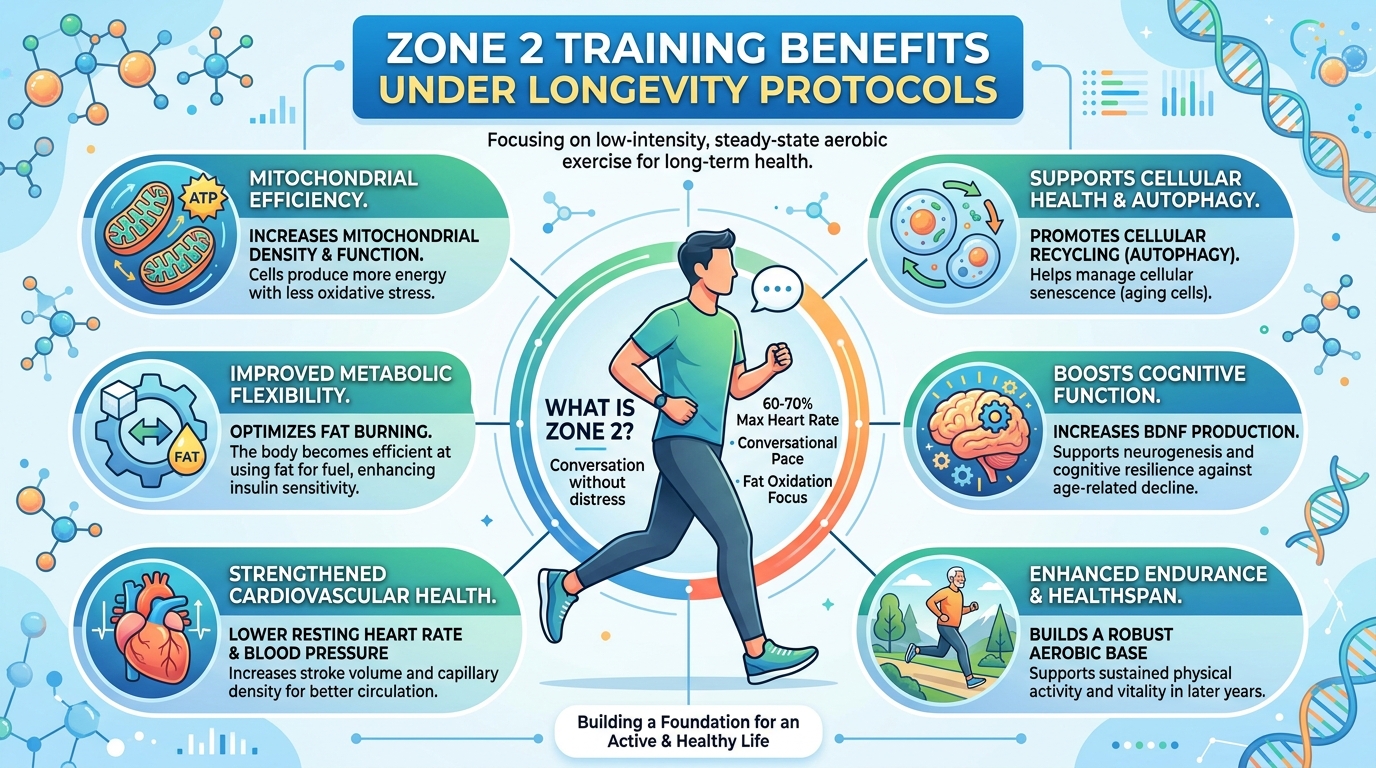
In a typical five-zone framework, Zone 1 is a gentle warmup, Zone 2 is steady easy effort, Zone 3 is a moderate grind, Zone 4 is hard, and Zone 5 is maximal. Most recreational exercisers spend far too much time in the murky middle of Zone 3, working hard enough to feel tired but neither easy enough to build a clean aerobic base nor hard enough to spike fitness.
Defining Zone 2 by your aerobic metabolism
The more useful definition ignores the chart and looks at your metabolism. The aerobic zone we call Zone 2 is the intensity at which your body draws most of its fuel from fat, your aerobic metabolism is working at a high but sustainable rate, and you produce only a little lactate, clearing it as fast as you make it. Lactate is a substance your muscles generate during effort. For decades it was misunderstood as a waste product, but it is actually a fuel and a signal, and we will come back to it.
Conversational pace and the talk test
The simplest field test costs nothing. Move at a conversational pace, where you can speak but would not want to sing. If you cannot manage full sentences, you have drifted too hard, into the fatigue-heavy middle zone. If you can recite a poem with no strain, you are loafing in Zone 1. That conversational-but-not-comfortable feeling is the sweet spot, and the talk test captures it surprisingly well.
Why maximum heart rate formulas mislead you
You will see Zone 2 described as roughly 60 to 70 percent of your maximum heart rate. Treat that as a rough starting point, not gospel. The popular “220 minus age” formula only estimates your max heart rate, and your actual max can sit well above or below it. Two people of the same age can have true thresholds 20 beats apart. Perceived effort and the talk test usually beat a number on a watch.
How to Measure Zone 2 Intensity
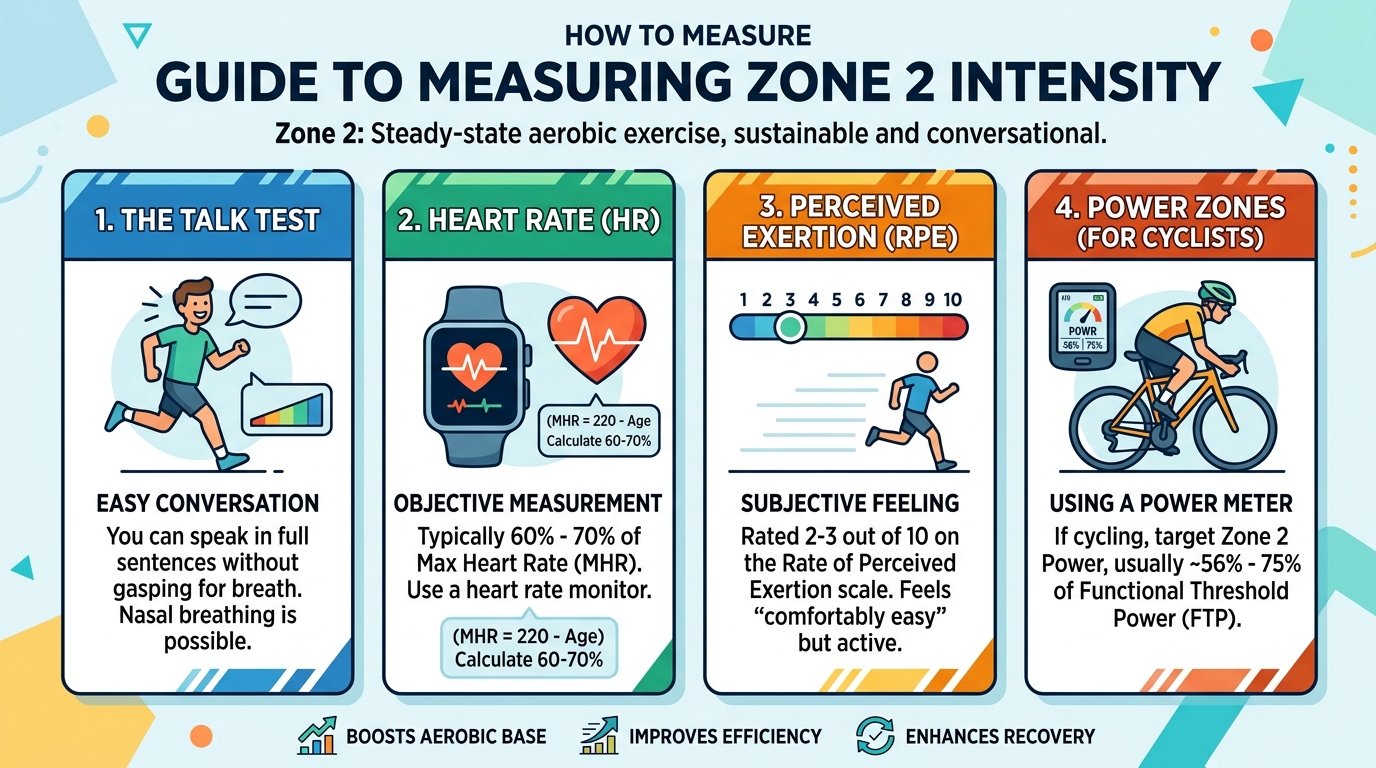
Getting the intensity right is the whole game, so it is worth understanding the options from most precise to most practical.
Lactate testing: the gold standard
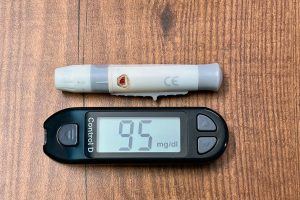
The gold standard for finding your true Zone 2 is lactate testing, which uses a small finger-prick sample to measure blood lactate at different efforts. Your lactate threshold, the point where lactate starts to accumulate faster than you can clear it, marks the top of Zone 2. This precise intensity measurement is what exercise labs and elite endurance athletes use.
Field methods for the right intensity
Most people do not need a lab. The talk test, perceived effort, and a heart rate monitor used as a rough guide will keep you close enough to the right intensity. A moderate effort that you could sustain for an hour, where conversation is possible but not comfortable, lands most people squarely in the aerobic zone. Precision is nice, but consistency at roughly the right intensity matters far more than chasing a perfect number.
The Mitochondrial Engine Behind the Benefits
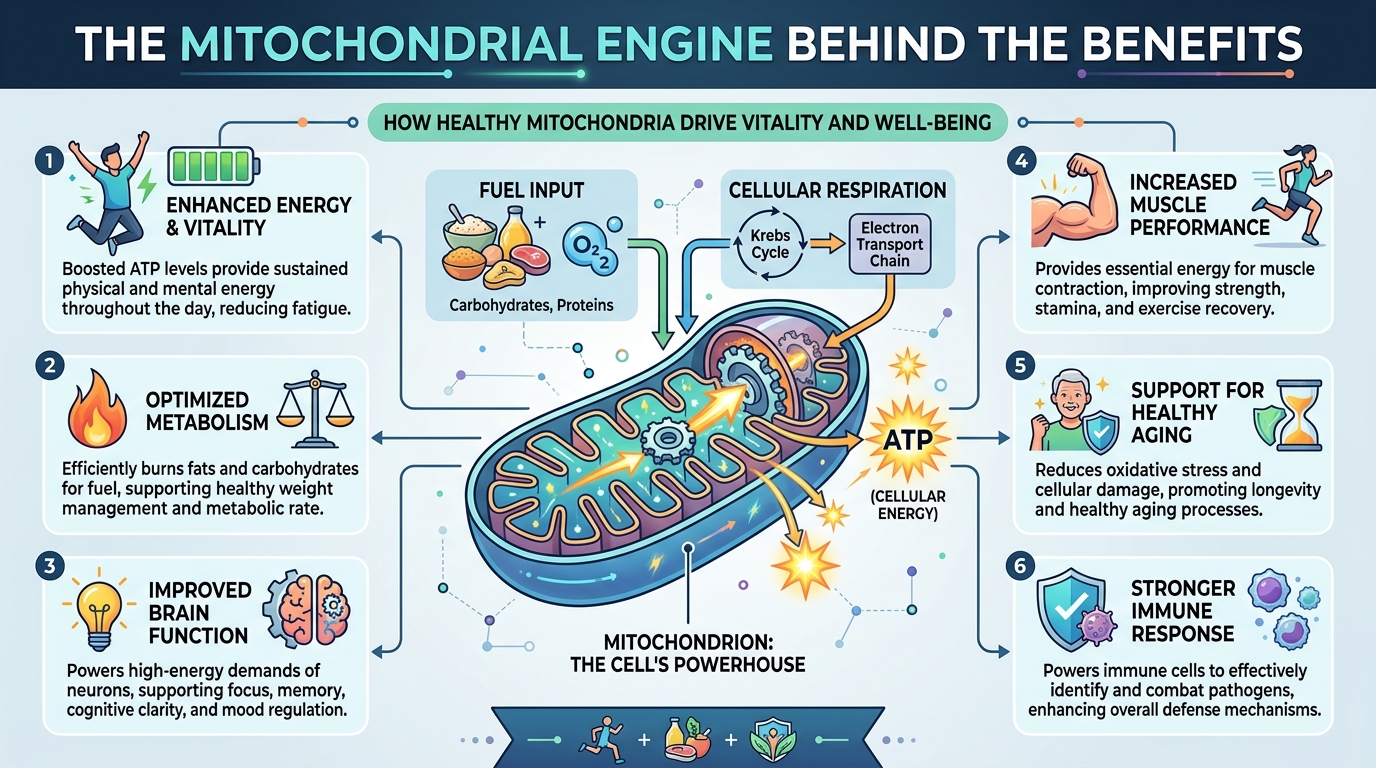
Here is where Zone 2 earns its reputation, and where the full mechanism gets genuinely interesting.
Mitochondria, explained simply
Inside nearly every cell sit tiny structures called mitochondria, the organelles that turn fat and sugar into usable energy. They are, almost literally, the engines of your metabolism. As we age, both the number and the quality of these engines decline, which quietly drags down everything from stamina on stairs to how cleanly your body handles a meal.
How easy effort drives mitochondrial biogenesis
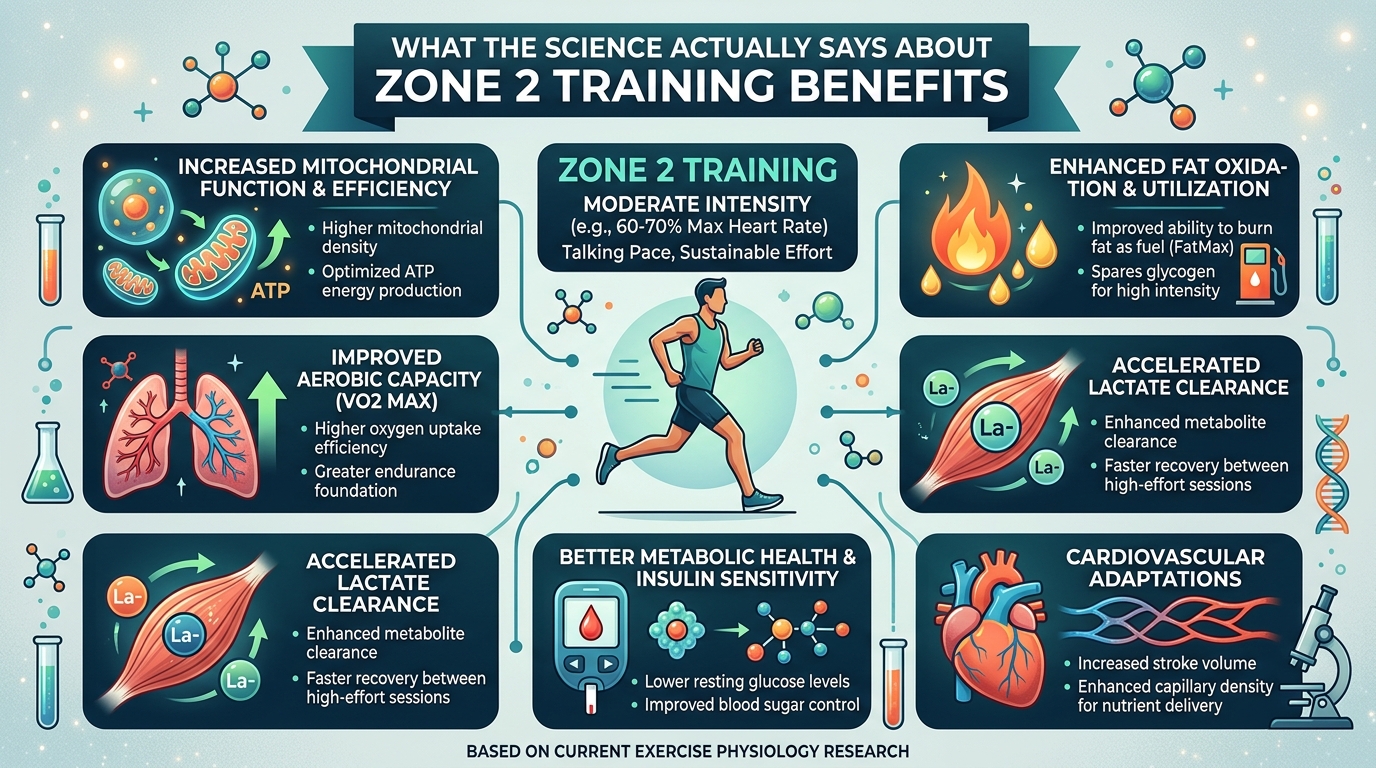
Exercise pushes back on that decline through a process called mitochondrial biogenesis, the building of new mitochondria. In a 12-week study, structured training improved mitochondrial function in both younger and older adults (Robinson, Cell Metabolism, 2017). The relevant point for Zone 2 is the direction of travel. Trainable aerobic work rebuilds the cellular machinery aging erodes, and this mitochondrial adaptation is the foundation of building aerobic capacity. More engines, working better, means more energy produced the efficient way, using oxygen and fat rather than burning quickly through limited sugar stores.
Capillary density and oxygen delivery
Easy aerobic work also expands the network of tiny blood vessels, the capillaries, that feed your muscles. Higher capillary density means better oxygen delivery to working tissue, which feeds directly into a higher VO2max and the longevity benefits tied to it (Mandsager, JAMA Network Open, 2018; Clausen, JACC, 2018).
The lactate story everyone gets backward
When you train in Zone 2, you teach your cells to shuttle lactate efficiently and burn it for fuel. Over time this raises the workload you can sustain before lactate accumulation forces you to slow down, a hallmark of a well-conditioned metabolism. The fittest endurance athletes are not the ones who avoid lactate. They are the ones whose cells clear and reuse it fastest.
What San-Millán's framework adds
The researcher most associated with the modern Zone 2 approach makes the strongest version of this argument. Iñigo San-Millán, PhD, who developed the framework while coaching elite athletes, argues that this specific easy intensity is the one that most strongly stimulates mitochondrial function and trains the body to clear lactate (paraphrased position; documented across his interviews on The Drive podcast and his 2023 paper in Antioxidants). In his telling, people with metabolic disease and elite athletes sit at opposite ends of the same mitochondrial spectrum, and Zone 2 is the lever that moves you toward the healthy end.
That framing is compelling. As we will see next, it is also where the evidence gets contested, and an honest guide says so.
The Fat-Burning and Metabolic Payoff
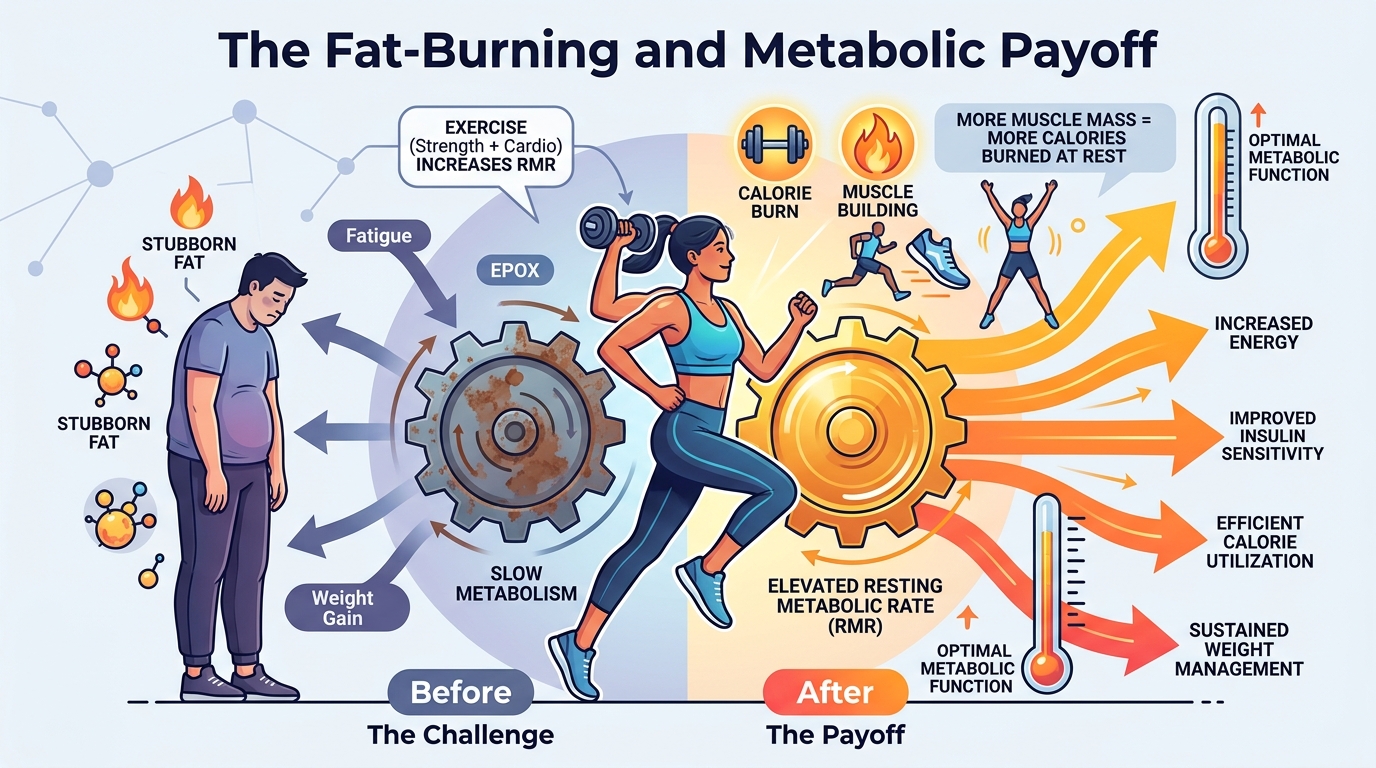
The longevity statistics are the headline. The metabolic changes are the mechanism, and they are the part you actually feel.
Fat oxidation and fat metabolism
In Zone 2, fat becomes your dominant fuel. Training this intensity improves fat oxidation, your capacity for burning fat efficiently for energy, and over time it reshapes your fat metabolism so you rely less on sugar at easy and moderate efforts. This is the metabolic skill that aging and inactivity tend to blunt.
Insulin sensitivity and blood sugar
Insulin sensitivity is your cells' responsiveness to the hormone that ushers sugar out of your blood and into your tissues. When it drops, blood sugar drifts up and metabolic trouble begins. Aerobic training improves it, and the Mayo Clinic study found that benefit across every exercise mode tested (Robinson, Cell Metabolism, 2017). Better mitochondria are the deeper reason, since the cellular bottleneck behind much metabolic disease is mitochondria that cannot cleanly burn fuel.
Metabolic flexibility and metabolic efficiency
Metabolic flexibility is the ability to switch smoothly between burning fat and burning carbohydrate depending on demand. A flexible, metabolically efficient body sips fat at rest and on easy efforts, then shifts to sugar when intensity rises. An inflexible one gets stuck on sugar. This flexibility erodes with age and metabolic dysfunction, and Zone 2 trains exactly the fat-burning side that aging dulls.
Metabolic health and the aging connection
Put these together and the longevity link stops feeling like a statistical fluke. The fitness that predicts longer life is built on mitochondrial and metabolic machinery, and Zone 2 is one of the most reliable ways to maintain metabolic health as the years pass.
This is one of the variables addressed in the WholeLiving 5-Month Health Challenge as part of a measurable biological age reduction system, because few inputs you control move the needle on healthy lifespan this reliably.
Zone 2 and Fat Loss: An Honest Look
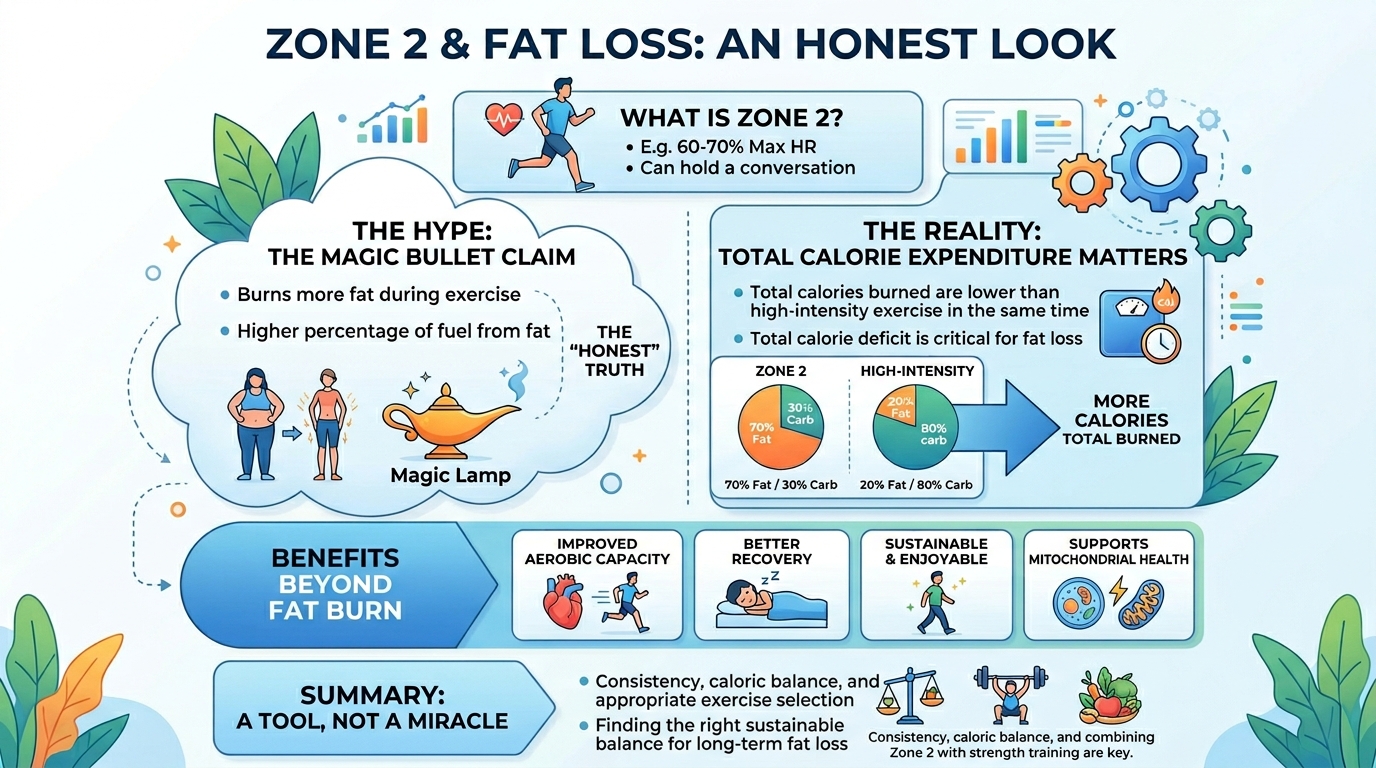
Because so many people come to Zone 2 hoping for fat loss, this section deserves straight talk rather than hype.
What Zone 2 does and does not do for fat loss
Zone 2 improves your ability to use fat as fuel during exercise, which is a real metabolic upgrade. But improving fat oxidation is not the same as guaranteed weight loss. Fat loss is governed mostly by overall energy balance, and burning fat during a workout does not automatically translate into a smaller fat mass if the calories return at the table.
Total energy expenditure and resting metabolic rate
Exercise contributes to your total energy expenditure, the sum of everything you burn in a day, but for most people that contribution is smaller than diet's influence on intake. Your resting metabolic rate, the energy you burn simply existing, makes up the largest share, and it is influenced more by your muscle mass than by any single cardio session. This is why training intensity and duration alone rarely drive dramatic body-composition change without attention to nutrition.
Body composition, visceral fat, and lean mass
Regular aerobic activity is consistently associated with better metabolic health across large populations (Lear, The Lancet, 2017), and improving fitness and metabolic flexibility supports a healthier body composition over time. Where Zone 2 genuinely helps is sustainability: it is low-impact enough to do often, which keeps you moving and supports the long-term habit that actually shifts visceral fat, the harmful fat stored around your organs. The honest framing is that Zone 2 is a powerful health tool that supports fat loss as part of a complete program, not a standalone fat-burning trick.
Pair it with resistance training to protect lean mass
To protect lean muscle mass and prevent the muscle loss that comes with aging and with weight loss, pair Zone 2 with resistance training (do this) → you preserve the lean mass that defends your resting metabolic rate and physical function (this happens) → consistent with the finding that resistance and combined training improved lean mass and insulin sensitivity (Robinson, Cell Metabolism, 2017) → which affects biological age by maintaining the muscle and metabolic capacity that normally decline over the decades.
The Cardiovascular and Brain Benefits
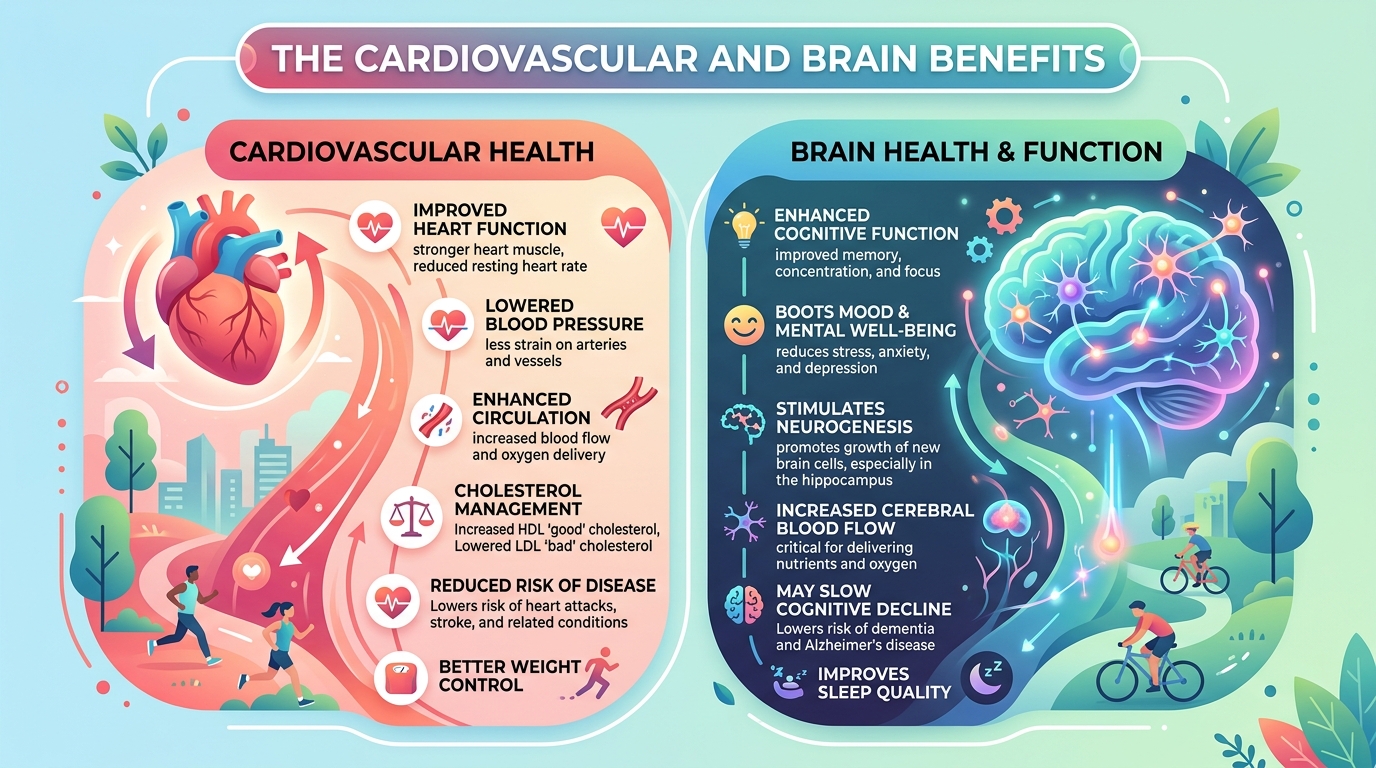
A stronger, more efficient heart
Steady aerobic training improves the heart's stroke volume, meaning it pumps more blood per beat. A heart that moves more blood with each contraction does not have to work as frantically to meet the same demand, which is part of why endurance-trained people often carry low resting heart rates.
Brain health and whole-body energy
Mitochondria are not only in muscle. They power nearly every tissue, including the brain, so the principle that aerobic training improves mitochondrial function (Robinson, Cell Metabolism, 2017) is part of why physical activity is so consistently linked to better outcomes across organ systems, including brain health. Beyond the statistics, most people who build an aerobic base report steadier daily energy and fewer mid-afternoon crashes. That is metabolic flexibility showing up in real time.
The Honest Catch: Zone 2 vs High-Intensity Interval Training
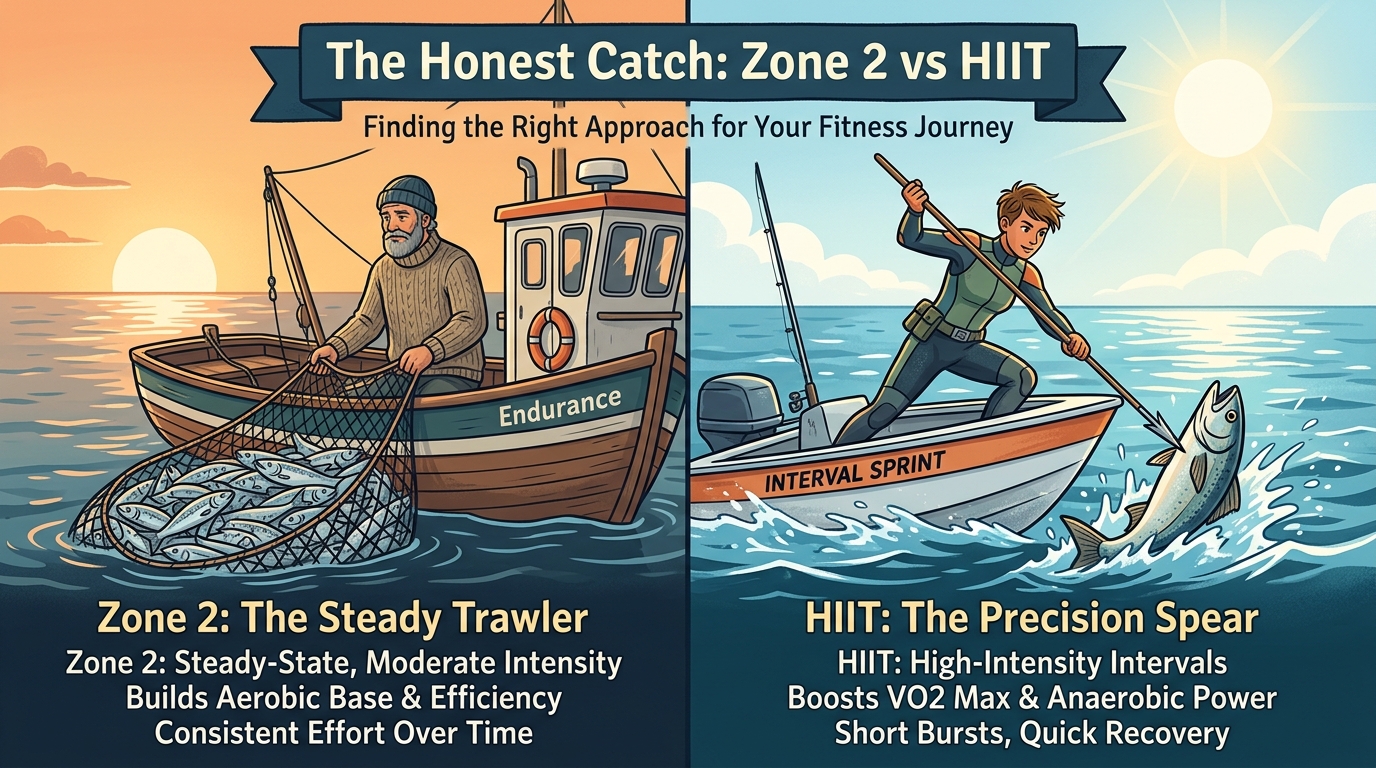
A guide that only sold you the upside would not be trustworthy. The popular claim that Zone 2 is uniquely best for mitochondria is not settled science.
What the head-to-head data shows
In that same 12-week Mayo Clinic study, the largest mitochondrial gains did not come from moderate steady state work. They came from high intensity interval training (Robinson, Cell Metabolism, 2017). Intervals produced especially strong improvements in older adults . The global activity data complements this, showing moderate movement captures most of the mortality benefit while additional vigorous activity adds more on top (Wang, JAMA Internal Medicine, 2021).
Same adaptation, very different cost
So why train Zone 2 at all if higher intensities build mitochondria faster per minute? Because the two pursue much the same adaptation by different routes, at very different costs. High-intensity work is potent but taxing, hard on recovery capacity, and easy to overdo. Zone 2 steady-state work is sustainable, low-impact, and something you can accumulate in real training volume week after week.
Why base plus intensity wins
The smart reading of the evidence is not Zone 2 instead of intensity. It is a large aerobic base of easy work, then a smaller, sharper dose of intensity on top. That combination respects both the mitochondrial data and the reality of a body that has to recover. Zone 2 is the foundation, not the entire house.
How Much Zone 2 You Actually Need
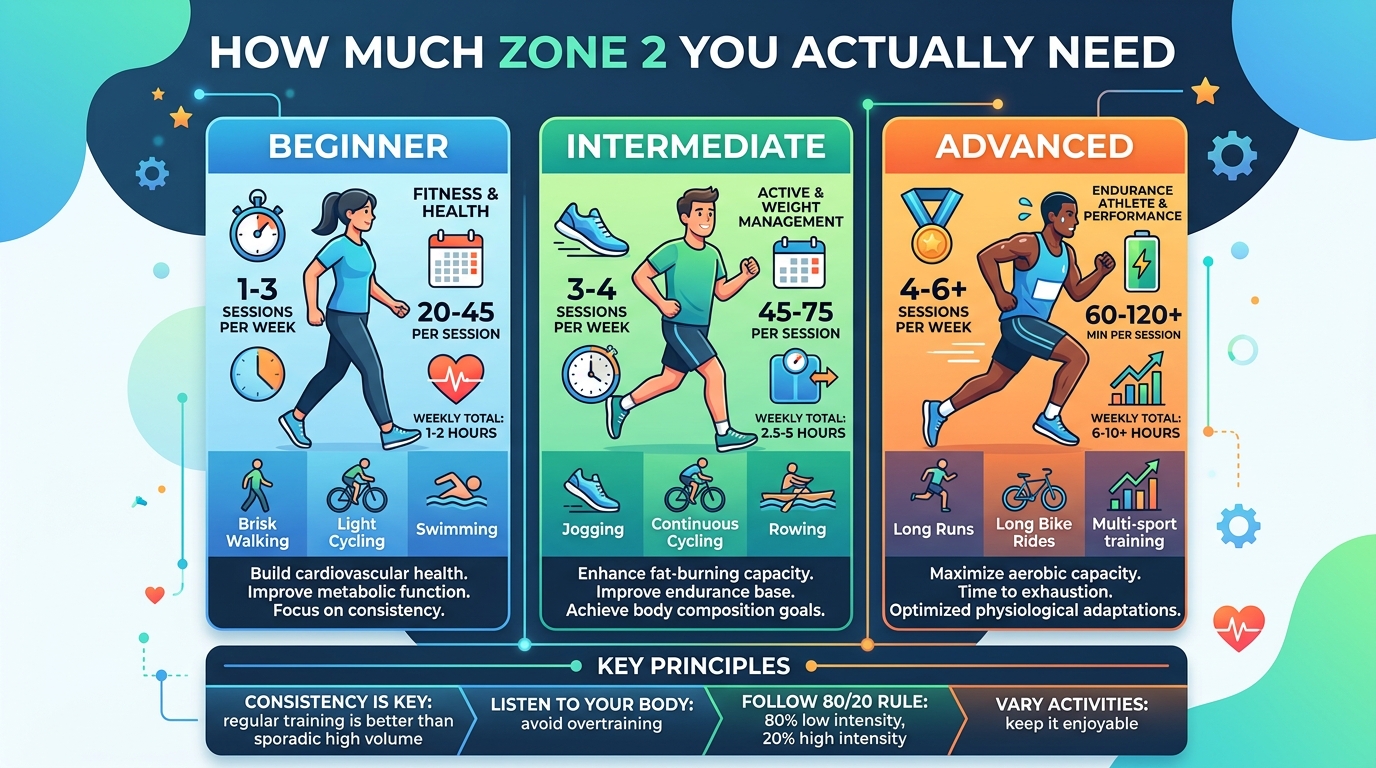
This is where the topic stops being abstract.
The weekly dose and training volume
In a cohort of 403,681 US adults, getting the recommended 150 to 299 minutes per week of moderate activity, versus none, was associated with roughly 17 percent lower all-cause mortality (Wang, JAMA Internal Medicine, 2021). The global PURE data points the same way (Lear, The Lancet, 2017). For Zone 2, that usually translates into three to four training sessions a week and enough total training volume to nudge fitness upward over months.
Most of the benefit comes from moderate movement
The encouraging headline is that the moderate, conversational-pace category where Zone 2 lives captured most of the available benefit on its own (Wang, JAMA Internal Medicine, 2021). You do not need to suffer to collect the bulk of the longevity dividend.
Session length and recovery capacity
Very short sessions give your aerobic system a weak signal, so most practitioners favor 45 to 60 minutes. Because Zone 2 sits below your lactate threshold, it places light demand on your recovery capacity, which is precisely why you can do it often without digging a fatigue hole.
How to Build Your Zone 2 Training Program
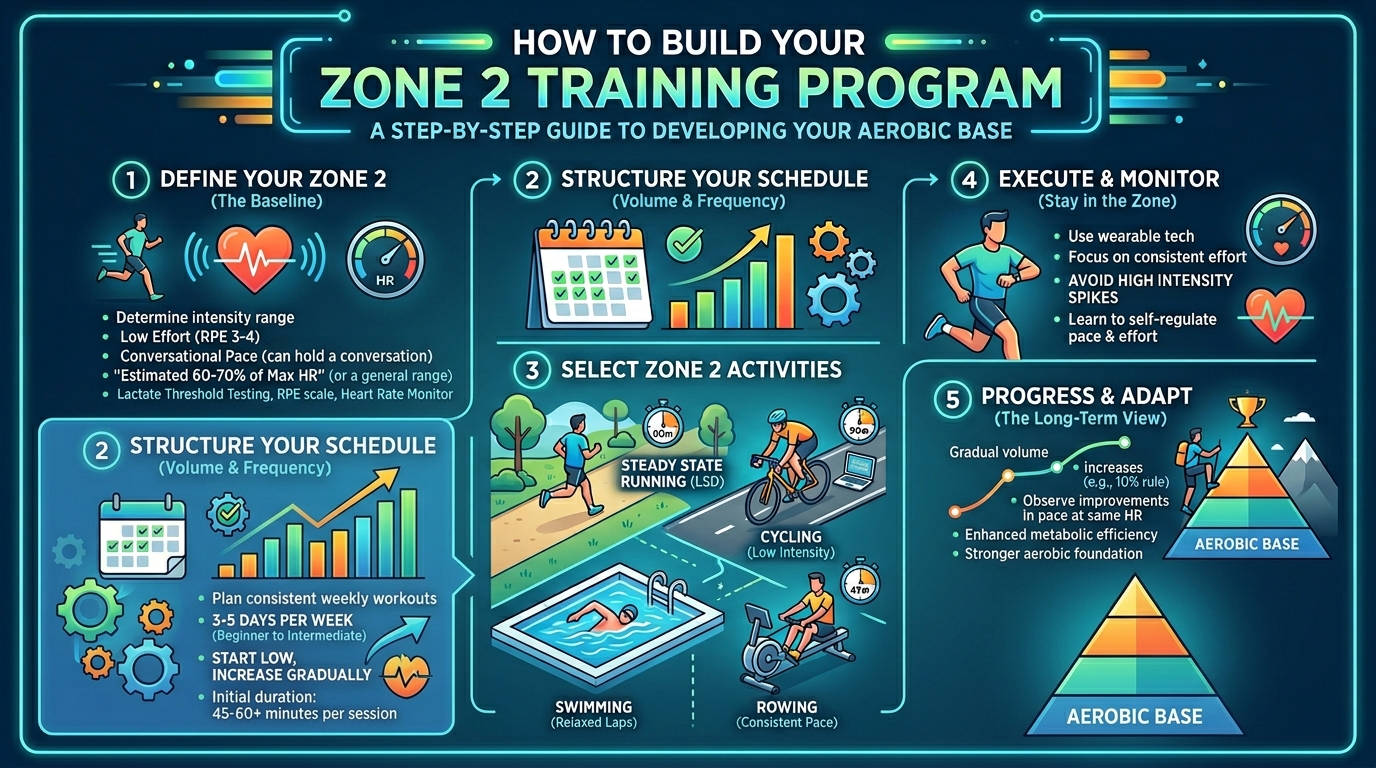
Here is the practical protocol, with each recommendation laid out as do this, this happens, on what basis, and why it matters for aging. Of all the training methods available, this is the one most people under-use.
Step 1: Find the right intensity
Keep your easy sessions genuinely easy, at the talk-test pace (do this) → your cells get more practice burning fat and clearing lactate, the hallmark adaptations of a healthy metabolism (this happens) → consistent with the mitochondrial improvements documented after structured aerobic training (Robinson, Cell Metabolism, 2017) → which supports a younger biological age by protecting the cellular energy production that normally fades with the years.
Step 2: Choose your activity
Pick something you can sustain at a smooth, steady output. Cycling, incline walking, rowing, and the elliptical work well. Outdoor running is often slightly too intense for true Zone 2 unless you are very fit, which is why many recreational runners end up walking uphill instead of jogging to stay in the aerobic zone.
Step 3: Set your weekly structure
Aim for three to four aerobic training sessions a week of 45 to 60 minutes (do this) → you accumulate enough weekly volume to raise cardiorespiratory fitness over months (this happens) → the same fitness that predicts longer life in the mortality data (Clausen, JACC, 2018; Mandsager, JAMA Network Open, 2018) → which affects biological age through the strong, dose-dependent link between higher VO2max and a longer healthy lifespan.
Step 4: Add a small dose of intensity
Layer one short higher-intensity session on top of your base (do this) → you stimulate the larger mitochondrial and VO2max gains intervals produce (this happens) → as shown when intervals outperformed steady-state training for mitochondrial capacity (Robinson, Cell Metabolism, 2017) → which compounds the biological-age benefit by raising your aerobic ceiling, not just your floor.
A sample training week
A workable training program for a busy adult might run three Zone 2 sessions of 45 to 60 minutes, one short interval session, and two resistance training sessions, with at least one full rest day. The exact layout matters less than the consistency.
How to track building aerobic capacity
The cleanest home metric is your pace or power at a fixed heart rate. As you build aerobic capacity, you move faster or push more watts at the same easy heart rate. That improvement is the visible sign of the invisible cellular work, and it shows up long before anything feels dramatic.
READ ALSO : Eating Before or After Workout: What Feels Best for You
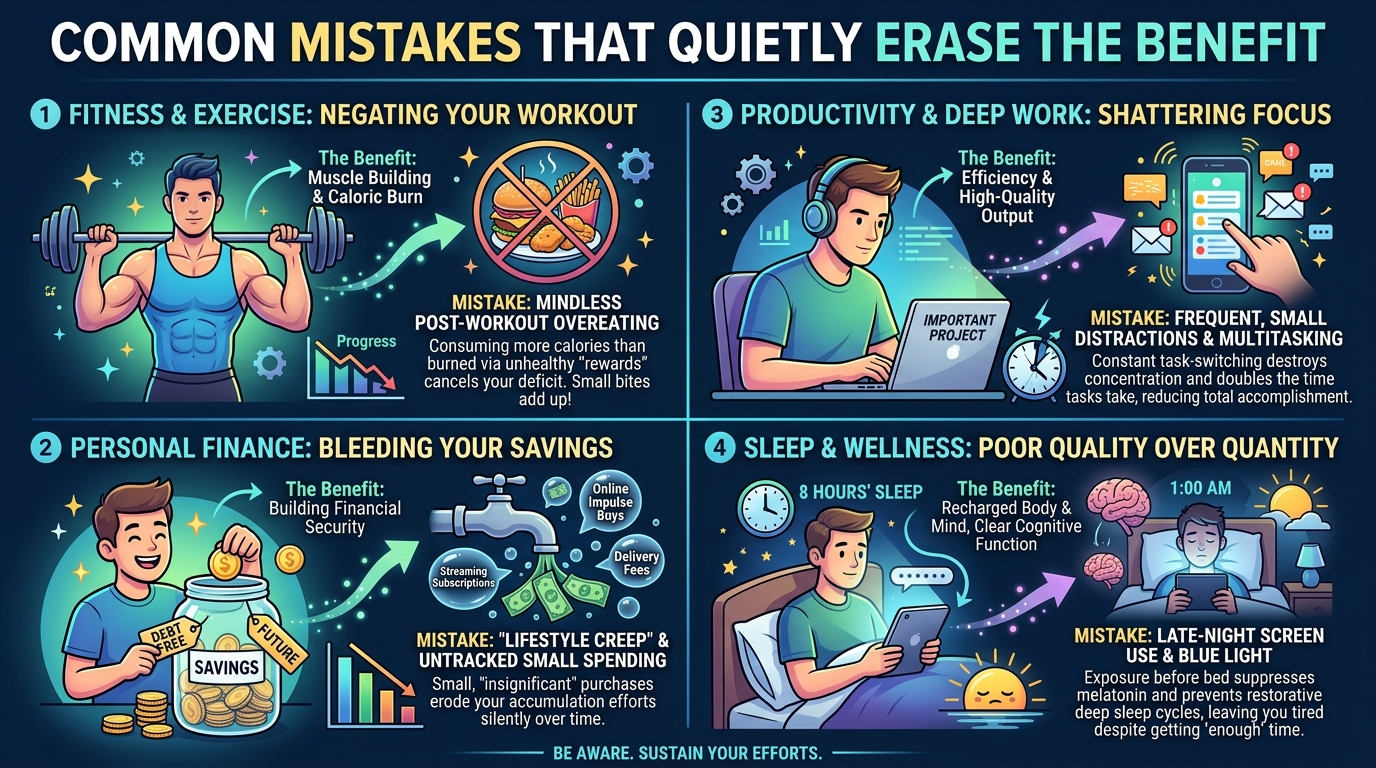
Common Mistakes That Quietly Erase the Benefit
Going too hard
The most common error by far. A truly easy pace feels almost lazy, so people unconsciously push into the moderate grind of Zone 3, which delivers fatigue without the specific fat-burning adaptation. Discipline to stay slow separates effective Zone 2 from junk miles.
Going too short
Brief sessions do not give the aerobic system enough of a signal. Twenty minutes is still worth doing, but the fuller benefit shows up with longer, sustained efforts.
Inconsistency
The mitochondrial and fitness changes the studies measured took weeks of repetition to appear (Robinson, Cell Metabolism, 2017). A brilliant week followed by three skipped ones will not build the base.
Treating it as a standalone fix
Easy cardio cannot outrun a wrecked sleep schedule, no strength training, or a chronically inflammatory diet. Treat Zone 2 as one pillar, not the whole structure.
READ ALSO : Fascia-Focused Workout – Whole Living Strength
Zone 2 for Different Starting Points
If you are a beginner
Start with brisk walking or easy cycling and the talk test. A pace that feels almost too gentle is usually right. Beginners often see the fastest relative gains, since the lowest-fitness groups have the most ground to make up and the steepest mortality benefit to capture (Mandsager, JAMA Network Open, 2018).
If you are a busy professional
Most of the benefit comes from moderate movement you can fit into ordinary life (Wang, JAMA Internal Medicine, 2021; Lear, The Lancet, 2017). Cycling commutes, brisk walking meetings, and incline treadmill time all count. The bar is lower than the fitness industry implies.
If you are a recreational runner or endurance athlete
This is where Zone 2 becomes performance, not just health. Elite endurance athletes spend the majority of their hours at low intensity precisely because that aerobic base supports faster racing later. Recreational runners who add structured Zone 2 to their endurance training, rather than grinding every run at moderate effort, typically build a bigger engine with less burnout.
If you are an older adult
Aerobic training improved mitochondrial function and metabolic markers in older adults specifically (Robinson, Cell Metabolism, 2017), and the longevity benefits of fitness extend well into later life (Clausen, JACC, 2018). Protecting muscle mass against age-related muscle loss with resistance training alongside Zone 2 matters even more with each passing decade. Anyone with a chronic condition should clear new exercise with a clinician first.
READ ALSO : Outdoor Workouts – Whole Living Cardio
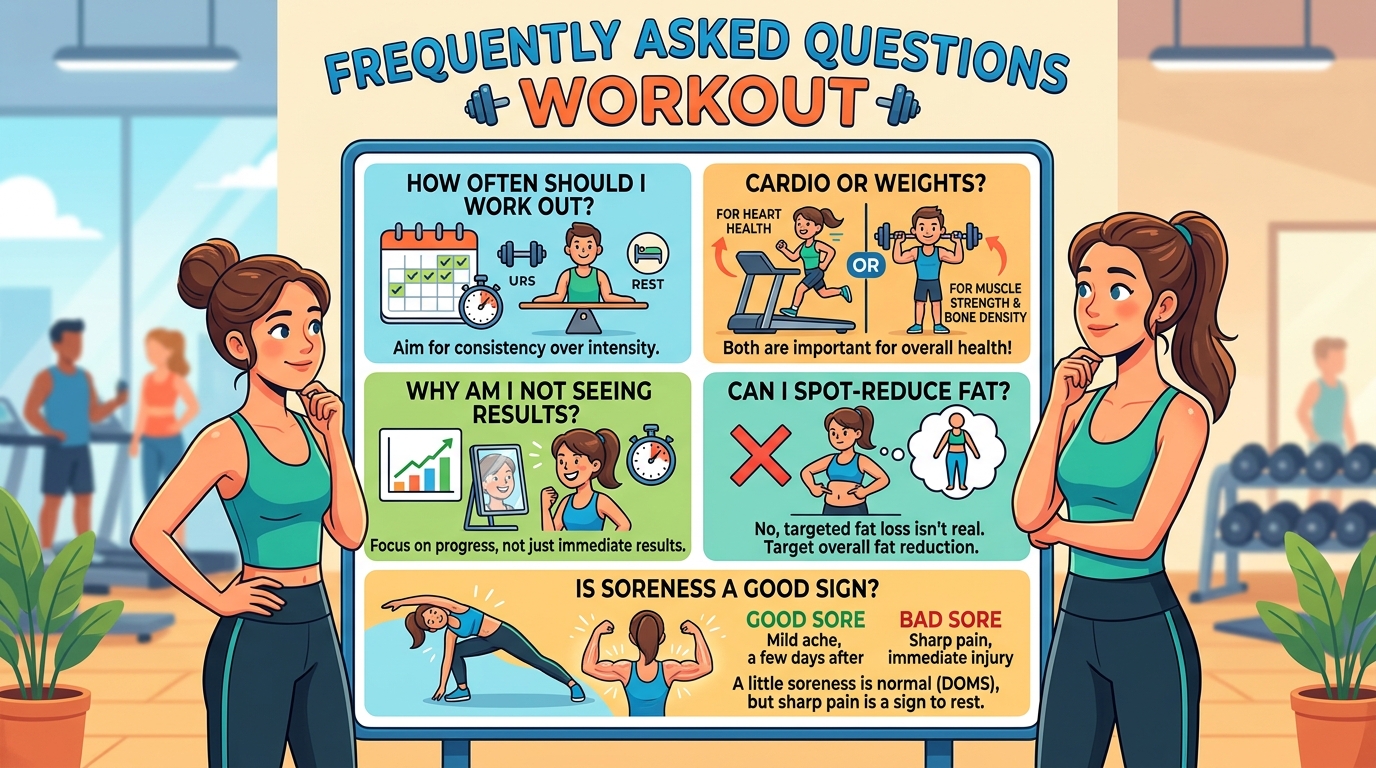
Frequently Asked Questions
Is walking enough for Zone 2?
For many people, especially beginners, brisk or uphill walking sits squarely in the aerobic zone. As you get fitter, add incline or pace to keep your effort in range. Intensity matters more than the activity.
Do I need a lactate meter or a fancy watch?
No. Lactate testing is the gold standard, but the talk test and perceived effort are reliable enough for almost everyone to get the Zone 2 training benefits described here.
How long until I see benefits?
Meaningful mitochondrial and metabolic adaptations were measured over about 12 weeks of consistent training (Robinson, Cell Metabolism, 2017). Steadier energy may come sooner, but think in months, not days.
Can I do Zone 2 every day?
Because it places light demand on recovery capacity, many people tolerate frequent Zone 2 well. Most longevity programs land at three to four sessions a week alongside resistance training and a little intensity.
Zone 2 versus high intensity interval training, which is better?
It is not either-or. Intervals build mitochondrial capacity and VO2max faster per minute (Robinson, Cell Metabolism, 2017), while Zone 2 builds a sustainable aerobic base with low injury risk. The strongest training methods use both.
Does Zone 2 help with fat loss and body composition?
It improves fat oxidation and supports metabolic health, but body composition is governed mostly by total energy expenditure and diet. Train Zone 2 for the metabolic and longevity benefits, protect lean mass with resistance training, and manage weight primarily through nutrition.
READ ALSO : DESKercise Simple Workout Routine
Key Takeaways
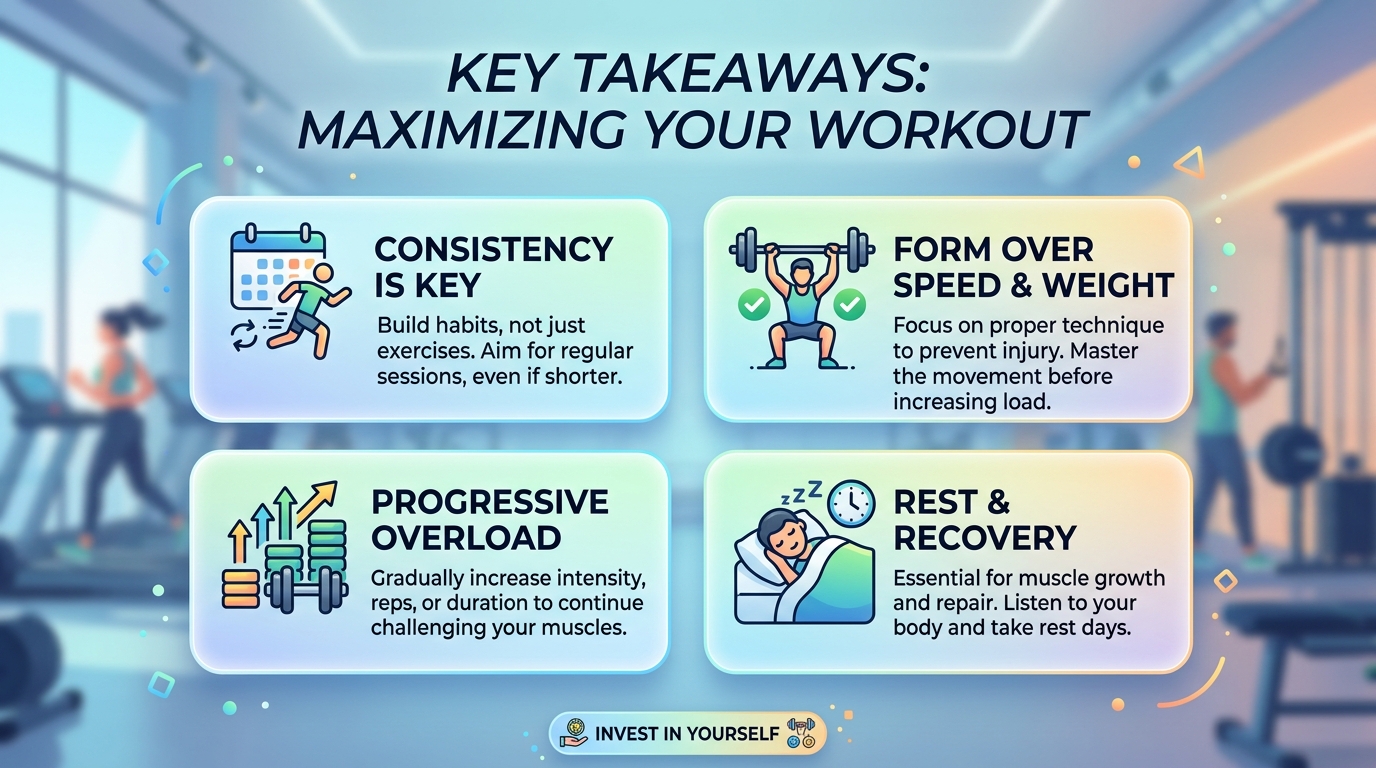
- Cardiorespiratory fitness is one of the strongest predictors of lifespan, scaling like a dose with no clear ceiling (Mandsager, JAMA Network Open, 2018; Clausen, JACC, 2018; Ross, Circulation, 2016).
- Zone 2 builds aerobic capacity by driving mitochondrial biogenesis, raising capillary density, and improving fat oxidation and metabolic flexibility (Robinson, Cell Metabolism, 2017).
- Find your intensity by conversational pace and the talk test; lactate testing is the gold standard but not required.
- For fat loss, Zone 2 is a supporting tool, not a magic bullet; total energy expenditure, diet, and protecting lean muscle mass with resistance training matter more.
- High intensity interval training may build mitochondria faster, but Zone 2 is the sustainable base; the best programs combine both.
- Aim for three to four training sessions a week of 45 to 60 minutes, plus a little intensity and regular resistance training.
Putting Zone 2 Training Benefits Into the Longer Game
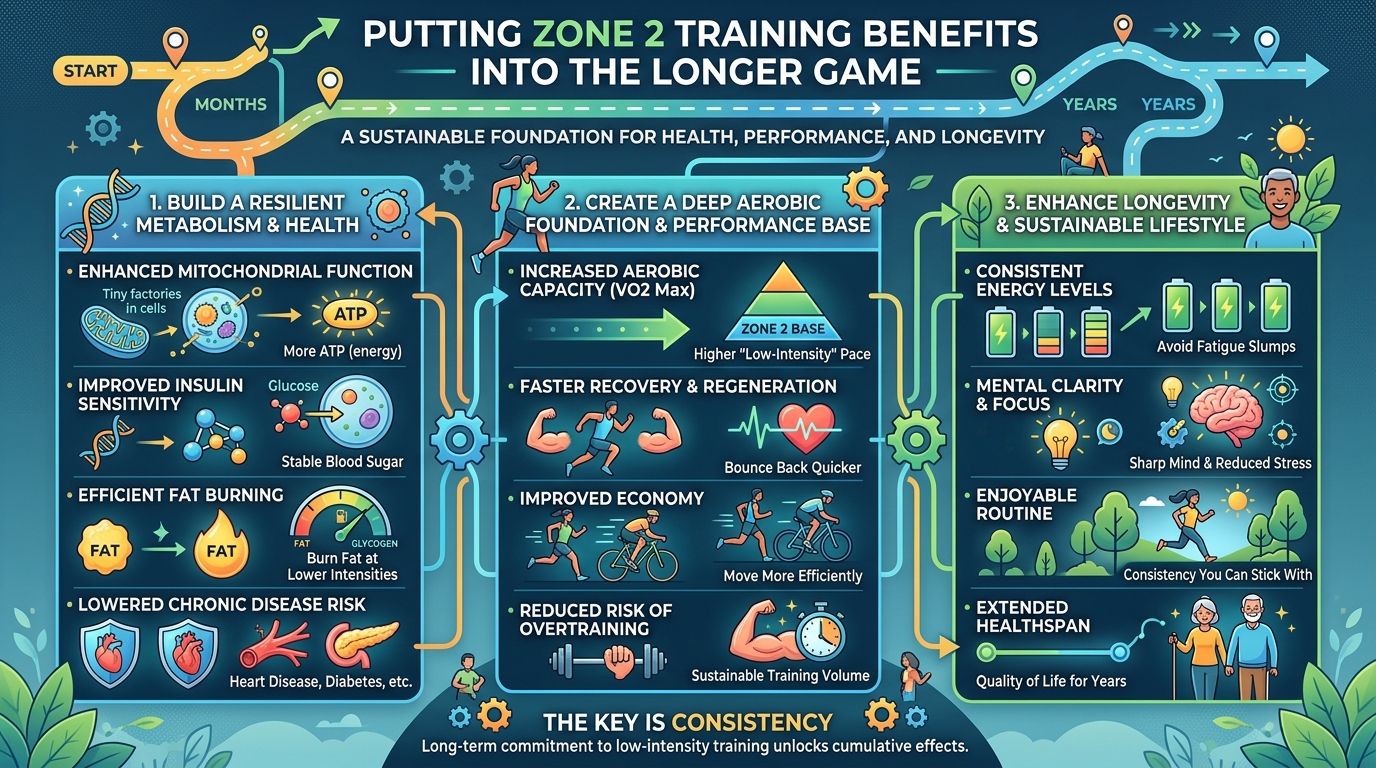
Step back and the picture is clear, including the honest caveats. Cardiorespiratory fitness is one of the strongest predictors of how long and how well you will live (Ross, Circulation, 2016). It scales like a dose rather than flipping like a switch (Clausen, JACC, 2018). Easy aerobic work is the most sustainable way to build it (Wang, JAMA Internal Medicine, 2021; Lear, The Lancet, 2017). And the mitochondrial story gives that link a believable mechanism, even if higher intensities build those engines faster (Robinson, Cell Metabolism, 2017).
Zone 2 is one piece of a larger picture. The WholeLiving 5-Month Health Challenge lays out the complete framework, showing exactly how aerobic training, high intensity interval training, resistance training, sleep, and metabolic markers fit together into a single measurable system for lowering your biological age. This article covers the cardio base. The Challenge connects it to everything else, with the testing and week-by-week structure to make it stick.
The real value of the Zone 2 training benefits in this guide is not that easy cardio is some secret. It is that the boring, repeatable training sessions build the exact aerobic engine the longevity data rewards, at a cost your body can sustain for decades. A younger biological age is built less by heroic effort and more by the patient accumulation of aerobic fitness over years. If you want the full framework that places Zone 2 alongside the other levers that move biological age, the WholeLiving 5-Month Health Challenge is the natural next step, turning this single habit into a measurable system you can actually follow.
This article is part of the Longevity Protocols pillar at WholeLiving and is intended for general education, not individualized medical advice. Anyone with cardiovascular disease, diabetes, or other chronic conditions should consult a clinician before starting or intensifying an exercise program.