In a 2016 study published in Science Advances, researchers analysed sleep patterns across 100 countries using smartphone data and found Singapore among the cities with the shortest average sleep duration globally — residents averaging under seven hours on workday nights. Duration, however, is only one variable. A person sleeping six and a half hours with intact slow-wave and REM staging may consolidate more effectively than someone sleeping seven and a half hours with disrupted architecture. The structure of sleep — the sequence, proportion, and depth of its stages — is where cognitive consolidation happens or fails to happen. This protocol addresses that structure directly.
Why Sleep Architecture Matters for Cognitive Consolidation
A full night's sleep cycles through four to six 90-minute rounds of distinct stages. N1 and N2 are light sleep; N3, or slow-wave sleep (SWS), is deep sleep characterised by large, slow neural oscillations called delta waves; and REM (rapid eye movement) sleep is the stage associated with vivid dreaming and active neural processing. The first half of the night is weighted towards SWS; the second half towards REM. This distribution is not arbitrary — it reflects the timing of different memory-processing functions.
When sleep is shortened, fragmented by noise or alcohol, or mistimed relative to the circadian clock, the first casualties are the stages at the tails: SWS at the start of the night and REM at the end. Cutting sleep by 90 minutes eliminates roughly half of the night's REM. For anyone managing sustained cognitive load across a full working day, the result is measurable: impaired declarative recall, reduced working-memory capacity, and degraded emotional processing the following day.
How REM and Slow-Wave Sleep Support Memory Consolidation
The two stages serve different memory systems, and both are required.
Slow-wave sleep is the primary window for declarative memory consolidation — the facts, events, and semantic knowledge acquired during the day. During SWS, the hippocampus (the brain structure responsible for encoding new information) replays recently acquired memory traces in compressed sequences, triggering a transfer of information to the neocortex for long-term storage. This hippocampal-neocortical dialogue is called systems consolidation, and it requires intact, uninterrupted deep sleep to complete. Diekelmann and Born (2010) in Nature Reviews Neuroscience established this model across multiple experimental paradigms and confirmed that SWS disruption specifically impairs hippocampus-dependent memory.
REM sleep serves a complementary function. Stickgold (2005) in Nature documented REM's central role in procedural memory — motor sequences, skill learning — and in the integration of new information with existing knowledge networks. The research suggests that adequate REM sleep in the latter half of the night is also associated with superior next-day performance on creative and associative tasks, making it relevant for work requiring synthesis rather than simple recall.
Both stages contribute to a structural maintenance function as well. Xie and colleagues (2013) in Science demonstrated that the glymphatic system — the brain's waste-clearance network, which runs through fluid-filled channels surrounding blood vessels — is most active during deep NREM sleep. During these hours it clears metabolic byproducts including amyloid-beta, a protein whose accumulation is associated with neurodegenerative processes. This is a parallel benefit of deep sleep that applies independently of memory consolidation.
READ ALSO: How VO₂max Predicts Cognitive Decline — and What to Do About It
Sleep Architecture Ranges: Standard Clinical vs. Longevity-Optimised
The table below draws on normative staging data from Ohayon and colleagues' 2004 meta-analysis in Sleep, which quantified sleep architecture across the lifespan in healthy individuals. The longevity-optimised column reflects ranges associated with superior cognitive outcomes in prospective research. These are reference points for understanding where your architecture currently sits, not targets to pursue without broader clinical context.
| Metric | Standard Clinical Range (Adult) | Longevity-Optimised Range | The Gap |
|---|---|---|---|
| N3 / Slow-wave sleep | 13–23% of total sleep | 20–25% of total sleep | SWS declines with age; the upper end is worth actively protecting. Up to 12 percentage points separate the clinical floor from the longevity target. |
| REM sleep | 20–25% of total sleep | Maintained at 20%+ beyond age 40 | REM is the first stage compressed by alcohol and sleep restriction. Keeping it above 20% past midlife is the specific cognitive objective. |
| Total sleep time | 7–9 hours | 7.5–8.5 hours | Sleeping at the lower clinical boundary (7 hours) does not allow completion of the full complement of late-night REM cycles. |
| Sleep efficiency | >85% | >90% | Time asleep ÷ time in bed. Below 85% signals fragmented architecture regardless of total duration. |
The Sleep Optimisation Protocol: Timing and Circadian Alignment
Circadian rhythm — the roughly 24-hour biological clock regulated primarily by light — determines when each sleep stage occurs within the night. Sleeping outside your biological window compresses or skips stages rather than shifting them intact. This is the mechanism behind the cognitive deficits seen in shift workers: even with equivalent total sleep hours, staging is misaligned with circadian-regulated hormonal release — specifically the growth hormone pulse that accompanies early-night SWS and the cortisol suppression that enables late-night REM. The National Institute of General Medical Sciences identifies circadian regulation as one of the most fundamental and consistent findings in sleep biology.
Step 1: Anchor your wake time. The research confirms that consistent wake times are more protective of sleep architecture than consistent bedtimes, because the wake time anchors circadian phase. Pick a wake time and hold it seven days a week. Reverse-calculate your bedtime by subtracting 8 hours. For most adults with a 7 am wake time, this means a bedtime of 11 pm — earlier than median practice in Singapore, but aligned with the first-night SWS window.
Step 2: Obtain morning light within 60 minutes of waking. Light exposure in the morning entrains the circadian clock and sets the timing of evening melatonin release. In Singapore's year-round tropical daylight, 10–15 minutes outdoors or near a bright window is sufficient. Skipping this step — common on work-from-home days — delays the evening melatonin peak and pushes sleep onset later, compressing the first SWS block of the night.
Step 3: Set a caffeine cutoff at 2 pm. Adenosine — the molecule that accumulates during waking hours and drives sleep pressure — is blocked by caffeine, which carries a half-life of approximately five to six hours in most adults. Caffeine consumed after 2 pm measurably reduces SWS even when sleep onset appears unaffected. Harvard Health Publishing identifies the afternoon caffeine cutoff as among the most consistently supported sleep hygiene recommendations across available studies.
READ ALSO: Zone 2 Training and Cognitive Performance: The Evidence
Sleep Environment: Temperature, Light, and Sound
Temperature. Core body temperature must drop by approximately 1°C from its daytime peak to initiate and sustain sleep. Research confirms that ambient room temperatures between 18°C and 20°C support this thermoregulatory drop most effectively in adults. In Singapore, where outdoor temperatures average 27–30°C year-round and indoor temperatures without air-conditioning remain in the mid-20s, achieving this range requires active cooling. Set your air-conditioning to 18–20°C approximately 30 minutes before your target sleep time. Running a ceiling fan simultaneously allows a slightly warmer set point — 21–22°C — while maintaining the sensation of airflow, which reduces energy consumption without a significant trade-off in sleep onset. Cleveland Clinic identifies temperature regulation as one of the most physiologically direct levers for improving sleep onset and depth.
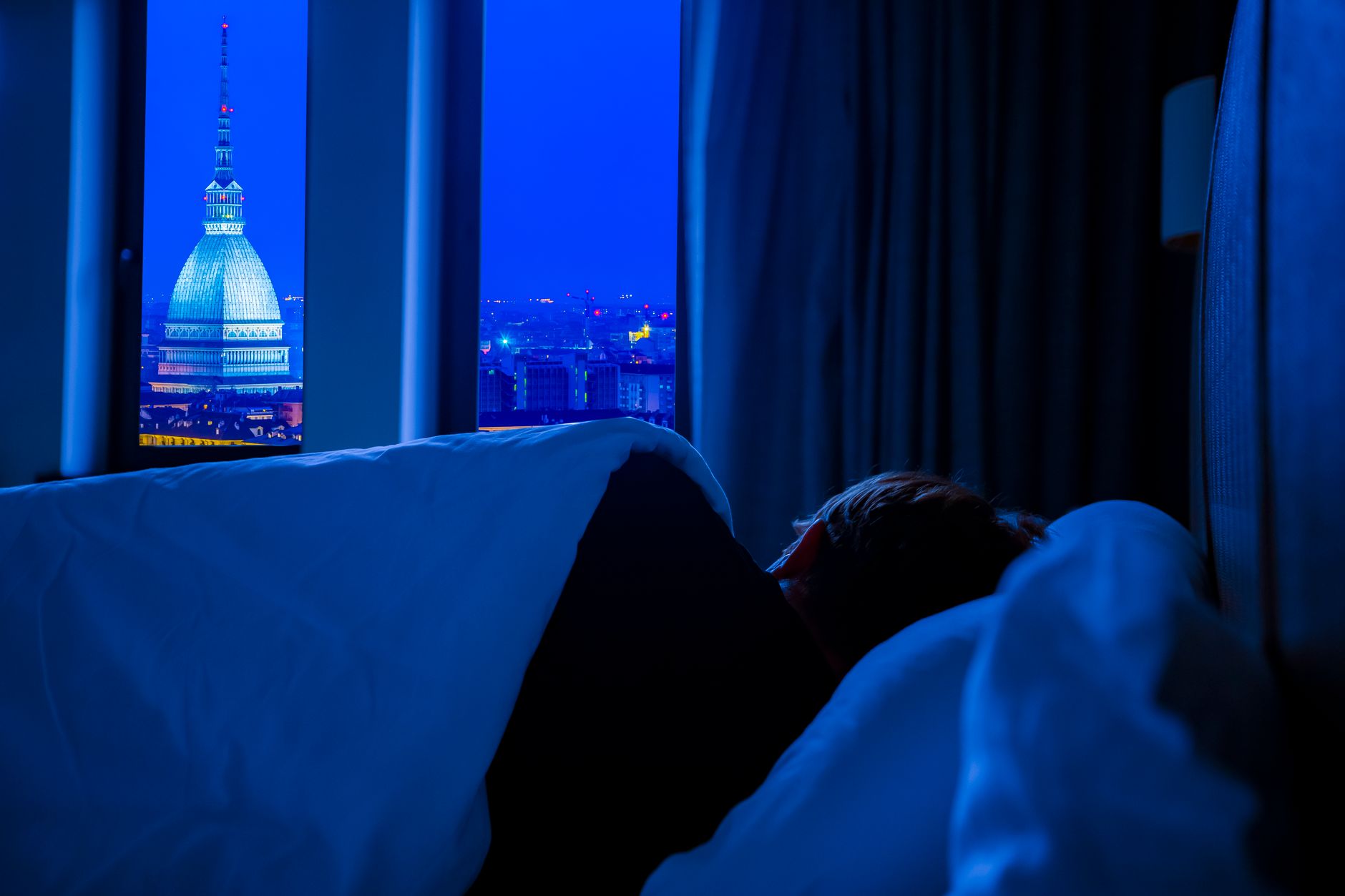
Light. Short-wavelength (blue) light suppresses melatonin secretion and delays sleep onset by shifting the circadian phase later. Chang and colleagues (2015) in the Proceedings of the National Academy of Sciences demonstrated that evening use of light-emitting screens delayed melatonin onset by approximately 1.5 hours, reduced REM sleep, and impaired next-morning alertness compared with reading a printed book under dim incandescent light. The practical steps: dim all screens after 9 pm, switch device displays to warm-spectrum night mode, and fit blackout curtains. In Singapore's high-density urban environment, ambient street and building light maintains meaningful illumination through the night — blackout curtains are not optional for those seeking to protect late-night REM cycles.
Sound. Noise above approximately 40 decibels during sleep triggers micro-arousals — brief partial wakings that fragment SWS and REM without fully rousing the sleeper. Consistent background sound (fan noise, white noise, or low-frequency pink noise) can mask irregular intrusion sounds more reliably than silence in a noisy building. Preliminary research indicates that pink noise timed to slow-wave oscillations may enhance N3 depth; this finding comes from smaller trials and should not take precedence over the higher-confidence temperature and light interventions. Earplugs remain a lower-cost, evidence-consistent option for those in noisy environments.
READ ALSO: Cortisol, Stress, and Working Memory: What the Data Shows
Pre-Sleep Behaviour and Sleep Initiation
Sleep onset requires two converging signals: adequate sleep pressure (accumulated adenosine) and aligned circadian timing (rising melatonin). Pre-sleep behaviour either reinforces or undermines both. The 30-minute window before your target sleep time has a disproportionate effect on whether the first SWS block arrives on schedule.
Step 4: Implement a 30-minute wind-down. The aim is to reduce physiological arousal — heart rate, skin conductance, cortisol — so the body can begin the cooling and melatonin ramp-up that precede sleep onset. Effective options include reading physical print, light stretching, or a brief warm shower. A warm shower or bath 60–90 minutes before bed accelerates sleep onset through peripheral vasodilation: blood moves to the skin surface to release heat, lowering core temperature. Cleveland Clinic's guidance on sleep initiation identifies this mechanism as clinically grounded and consistent across adult study populations.
Step 5: Avoid alcohol within three hours of sleep. Alcohol functions as a sedative and reduces sleep latency, creating a misleading impression of improved sleep. The research confirms that it suppresses REM sleep in the second half of the night — precisely when REM density peaks under healthy conditions — and fragments SWS through acetaldehyde-driven arousals as metabolism proceeds. The National Institute on Alcohol Abuse and Alcoholism documents this REM-suppression effect consistently across its published research base, including at moderate intake of one to two standard drinks. The effect on next-day cognitive function is measurable even without a subjective hangover.
Step 6: Reserve the bedroom for sleep. Using the bedroom for screens, work, or cognitively demanding tasks creates a conditioned association between the sleep environment and arousal, which lengthens sleep latency and increases night-time waking. Mayo Clinic's guidance on insomnia describes stimulus control — systematically restricting bed use to sleep — as one of the most robust behavioural interventions for sleep quality, with consistent support from randomised controlled trial evidence.
Tracking Your Sleep Architecture Progress
Consumer wearables infer sleep stages from accelerometer and photoplethysmography data — measuring movement and blood-oxygen fluctuations as proxies for neural activity. They are not polysomnography (the clinical standard, which measures EEG directly), and their staging accuracy has documented limitations. The Sleep Foundation's review of consumer tracking accuracy finds that modern devices perform adequately at distinguishing sleep from wakefulness and approximate staging, but underestimate N3 and have higher misclassification rates for REM. Use the data as directional trends over weeks, not as precise staging reports.
Metrics worth tracking on a rolling seven-day average:
- Sleep efficiency (time asleep ÷ time in bed × 100): target above 90%
- Deep sleep percentage (device proxy for N3): target above 18–20%
- REM percentage: target above 20%, particularly on nights with seven or more hours
- Sleep latency (time to fall asleep): 10–20 minutes is typical; consistently under 5 minutes suggests accumulated sleep debt
- Wake-after-sleep-onset (WASO): time spent awake after initial sleep onset; under 30 minutes is within normal range for most adults
Single-night data is subject to high variance and should not drive protocol adjustments. If your rolling deep-sleep percentage remains below 15%, or sleep efficiency below 80% for more than two consecutive weeks, consult your clinician — persistent architecture disruption may warrant formal assessment rather than further protocol adjustment.
READ ALSO: Omega-3 and Brain Function: What Singaporean Adults Need to Know
Integrate This Protocol Into Your 30-Day System
This protocol is one step in a 30-day sequence. The 30-Day Biohacking Starter Guide gives you the full system, including what comes before and after this step. Sleep architecture optimisation interacts directly with exercise timing, light exposure, and nutritional decisions made across the full day — the guide sequences all of these into a day-by-day protocol built specifically for Singapore's environment and climate.
UP NEXT: HRV as a Cognitive Stress Monitor: A Practical Protocol
Medical disclaimer: The content on this page is intended for educational and informational purposes only. It does not constitute medical advice, diagnosis, or treatment, and is not a substitute for consultation with a qualified clinician. Do not make changes to your sleep protocol, medications, or health behaviours based solely on this content. If you experience persistent sleep difficulties, excessive daytime sleepiness, or any other sleep-related concerns, consult a clinician. WholeLiving is not a clinical service.
—